Storyworld Hospitality: What Disney Understands That Most Restaurants Don't
You do not need Disney's budget to steal Disney's method. Coherence is cheaper than scale, and it matters more.
On Saturdays, for a stretch of years in the 1940s, a man in his forties sat on a bench in Griffith Park in Los Angeles with a bag of peanuts, watching his two young daughters ride the merry-go-round. Picture it properly, because he certainly did. The band organ wheezing through its rotation. The painted horses rising and falling on their brass poles. The specific boredom of a parent at a carousel, where the ride is a loop and your job is to wave every time your kid comes around, roughly once per waving impulse. He waved. He ate peanuts. The horses went around, and around, and around.
The account we have of that bench is his own, told years later, more than once: sitting there while the girls rode, he started thinking that there ought to be some kind of place where parents and children could have fun together. Not a park where the kids ride while the adults check their watches from a bench. A place built for both of them at once.
I take the story with exactly one grain of salt, because the man in question built an empire on storytelling and was, unsurprisingly, gifted at telling his own. But he told it himself, on the record, so the bench belongs to history: Walt Disney, Griffith Park, a bag of peanuts, and an idea forming at carousel speed.
Now jump ahead. July 17, 1955. Anaheim, California, on former orange groves. The temperature is around a hundred degrees. Main Street's asphalt went down so recently that it is still soft, and it spends the day quietly eating women's high heels. The event is an invitation-only preview, planned for a controlled crowd; thanks to counterfeit tickets, the crowd that pours in is roughly double what anyone planned for. A plumbers' strike has forced a last-minute choice between working drinking fountains and working toilets. Disney chooses toilets, which is the correct call, and gets accused of scheming to sell more soda anyway. (An accusation, I will note, that nobody has ever leveled at me, despite my running an actual soda lounge and therefore having superior motive.) Rides break down. A gas leak shuts down part of Fantasyland. The whole beautiful disaster goes out live on national television, co-hosted by a future president of the United States, in front of an enormous share of the country. Walt called the day Black Sunday for the rest of his life.
And here is the punchline. It did not matter. About seven weeks later, the one millionth guest walked through the gate.
Somewhere between the bench and Black Sunday sits the idea I care about most in my working life. An imaginative person has to create permission for everyone else to participate. Somebody has to build the castle before everyone agrees to pretend there is a kingdom. Nobody standing on that soft asphalt in 1955 was confused about what Sleeping Beauty Castle was made of. They pretended anyway. Together, in public, in hundred-degree heat, adults and children at the same time, because one man had spent seventeen million dollars, some of it borrowed against his own life insurance, which is documented and remains an alarming way to finance whimsy, building the pretending a place to happen.
Here is why any of this belongs on my website. I run an independent soda lounge in Burlington, Vermont. I cannot afford the castle. Neither, statistically, can you. The good news, which took me an embarrassing amount of time to understand, is that the castle is not the transferable part. Almost nothing that makes themed entertainment actually work is the expensive part. The transferable part is the method.
The method
Simplifying aggressively, three habits separate a themed environment from an ordinary one.
The first: the environment carries story. In a themed land, the streetscape, the shopfronts, the interior detail, the typeface on the signage, all of it is participating in telling you where you are. Nothing is neutral. A neutral surface is a wasted surface, and the method treats waste as a design failure rather than a default.
The second: details imply a world beyond what you can see. A prop that suggests somebody was using it recently and will be back. A sign for a business that does not exist. Wear patterns that imply decades of traffic that never happened. The guest only ever sees a small fraction of the world, and the composition of that fraction is what makes them believe in the rest. This is the same trick a good film production designer plays, and it is arguably the same trick a good novelist plays. You do not build the whole world. You build the corner of it that implies the whole.
The third: the guest is a participant, not an audience. They enter a place. They move through it, choose their own path, linger where they want to linger. Nobody straps them to a chair in front of a show. Even on the rides where they are literally strapped to a chair, the fiction is that they are inside the story, not watching it.
Notice what is missing from those three habits: a budget. Each one is a decision, not a purchase. Which makes it genuinely strange how completely absent they are from the average independent restaurant, including very good ones. The typical room, even the expensive typical room, is decorated rather than storied: nice materials, considered palette, no point of view. Strip the signage and you could not say what world you were in, because you were not in one. Nothing implies anything beyond the walls. And the guest is an audience: they enter, sit, receive service, leave, and affect nothing. None of this is a moral failing. It is a room doing a fraction of its available job, because nobody ever told the room it had one.
Storyworld hospitality is my working name for closing that gap: the deliberate application of themed-entertainment method to independent hospitality. The name is mine. The practice emphatically is not. The great tiki bars were doing it in the 1930s, when Don the Beachcomber dressed a Hollywood storefront in nets and lanterns and salvage until it implied an entire fictional biography. Dinner theater has always done a version of it. Video games have spent forty years perfecting environmental storytelling, training a couple of generations of players to read rooms for narrative the way earlier generations read books. I am standing on a very tall pile of other people's work and pointing at it.
What is actually new is the price of admission. Visual development, prop fabrication, sound design, video, interactive web experiences, even original character IP: these now cost what a small operator can genuinely spend. Some of the toolkit is AI-assisted. Some of it is 3D-printed. Some of it is just commodity fabrication getting cheap while nobody was watching. The tools that used to belong exclusively to studios and parks fell off the truck, and remarkably few people in my industry have noticed them lying in the road.
The cheap tools
Start with the two levers already installed in every room you will ever operate: sound and light. The playlist is the score. It carries genre, era, and mood, and a specifically curated musical program will tell a guest what world they are standing in faster than any object you can nail to a wall. Lighting decides the rest. Temperature, level, placement: the difference between a generic room and an unmistakable one is often just the difference between lighting a space and lighting a scene. Film crews understand this so deeply they put it above food on the call sheet. Restaurants, on average, do not understand it at all.
Language is free. The way the menu reads, the way the staff talk about what they are serving, the way the signage phrases itself: all of it is world-building at zero marginal cost. Paper is nearly free. A menu can be an artifact. A drink card can imply a longer story than it tells. A coaster can carry a joke that only makes sense inside the room. Ritual is entirely free: specific things that happen at specific times because the world calls for them, which regulars learn the way you learn the customs of a place you love visiting.
Objects cost the same either way, which is the interesting part. A decorator's shelf and a curated shelf contain roughly the same number of objects at roughly the same price. One of them is generically pleasant. The other implies a history, a character, an era, an unfinished story. The difference is not money. The difference is whether anybody made a decision.
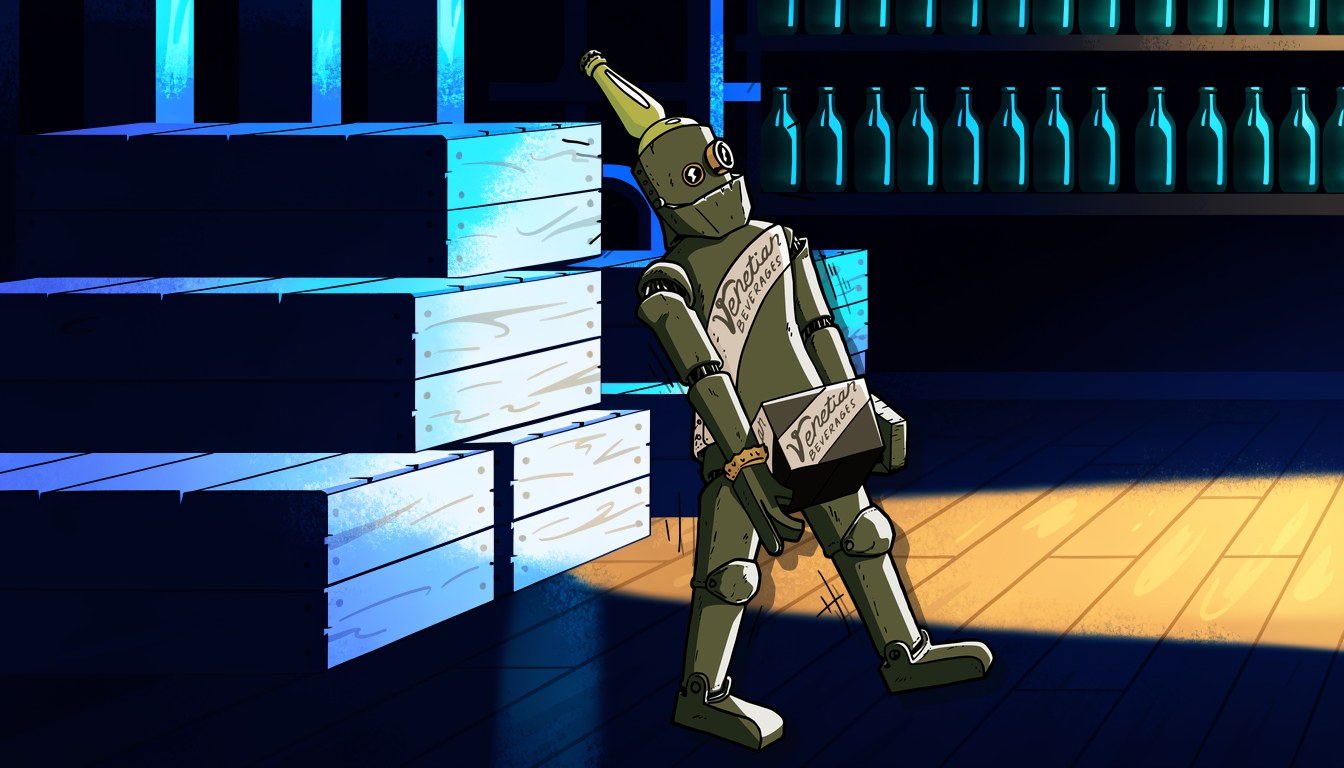
Then there are the levers that sound expensive and no longer are: characters and digital extensions. At Venetian, which opened in August 2022, there is a fictional pulp-adventure explorer named Rufus Hightower living underneath the room, with lore documents, expedition dossiers, themed live events, and a playable web demo. I wrote about him properly in Rufus Hightower and the Case for Giving a Business Its Own Mythology. There is a robot mascot named Gingy 9000 fronting the beverage side of the operation, who gets his own essay in Gingy 9000. There is SodaBarVT, an interactive case-file mystery on the web that takes place in the same universe as the physical room. I list these not as a portfolio flex but as evidence about price: an independent soda lounge in Vermont built all of them. That fact would have been implausible fifteen years ago. It is now just a Tuesday.
Events belong on the list too, with one condition. A themed night hanging off nothing but the calendar is decoration with a date. A themed night that hangs off a coherent world is a chapter, and chapters compound. Returning guests do not just attend the next one. They follow it.
Coherence, and knowing when to stop
The discipline that makes all of this work is coherence, and it is where independent operators most often fail while Disney is most conspicuously ahead. Disney themes its trash cans. Each land gets wastebaskets designed to belong to that land, which sounds like madness until you understand it as the operating principle rather than a quirk: nothing inside the world is exempt from the world, including the garbage. There is an oft-repeated story, polished smooth by retelling, that Walt personally watched guests to see how far they would carry trash before dropping it, and spaced his cans accordingly. I cannot vouch for the anecdote. I can vouch for the principle, because you can walk through any of the parks today and watch it holding.
The reason coherence matters so much is that worlds fail at their weakest point, not their average. Every element the guest encounters must point at the same world: the music, the menu, the uniforms, the napkins, the website, the emails, the social feed. Any single one of them defecting is enough, because one anachronistic object tells the guest, instantly and wordlessly, that the world is a marketing exercise rather than a place. And a broken world does not quietly repair itself. Guests can feel the crack even when they cannot name it.
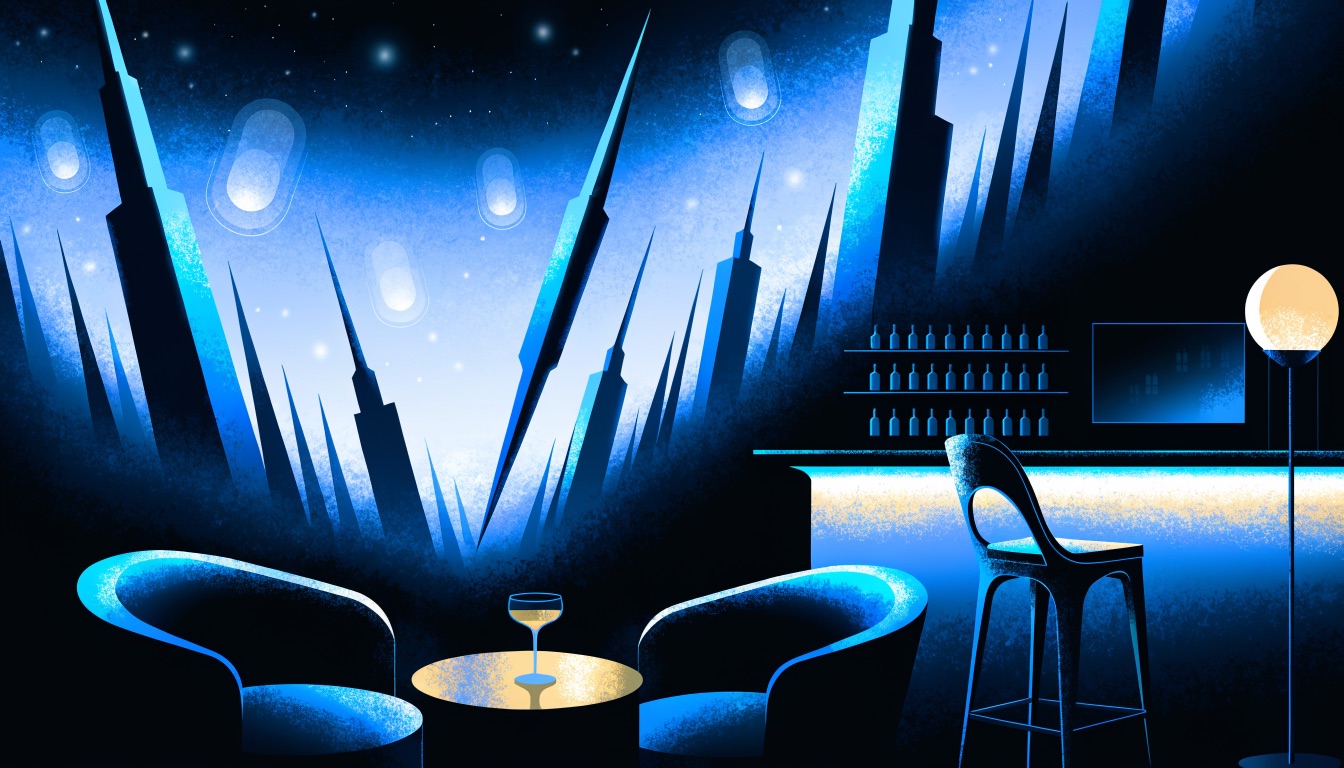
The counterweight to coherence is restraint, and it matters just as much. A room trying too hard curdles into camp. A business that leads with its lore becomes homework, and nobody wants a scavenger-hunt clipboard standing between them and a drink. The rule I hold myself to: the storyworld belongs in the guest's peripheral vision, not the center of it. Layer one has to be a great bar, full stop, judged as a bar. Layer two is the world, offered free to anyone curious enough to notice. If layer one ever depends on layer two, I have built the wrong thing and it is time to quietly take some props off the shelf.
If you forced me to compress everything themed entertainment knows into a single sentence, it would be this: guests want to enter a place, not be sold at inside one. That reframe changes what a room is for. It stops being a container for transactions and becomes a destination in the old sense of the word, a place with its own logic, where being inside it is the reward. And it is the one advantage a chain cannot requisition. A chain can copy your menu, your layout, your prices, and your entire brand identity by next quarter. It cannot copy the specific weight of a specific room built by a specific person with a point of view about the world it contains. Coherence is the moat. Scale turns out to be optional.
Which is why, out of the whole Disneyland story, the part I keep returning to is not the castle, and it is not Black Sunday, and it is not even the seventeen million dollars. It is the bench.
The castle had exactly one man in the story who could build it. The bench is available to everyone. Sitting still inside your own place, watching actual people use it, noticing what the room refuses to let them become, and then taking that notion seriously enough to build for it: that practice scales down all the way to a soda lounge in Vermont, and presumably to whatever you run too. Walt's real invention that Saturday was not a park. It was noticing that the carousel had seating for the children and a bench for everyone else, and deciding the bench was a design flaw in the world.
The kingdom came later, and it was optional. The permission was the invention. Build the bench-sized version of that, whatever it is in your room, and the pretending will find you. It always finds a world that means it.
The castle cost seventeen million dollars. The bench was free.
Related: Rufus Hightower and the Case for Giving a Business Its Own Mythology, The Guest Is Not the Audience. The Guest Is the Character, The Five Layers of Immersive Hospitality.