Rufus Hightower and the Case for Giving a Business Its Own Mythology
Most brands live at the surface. A storyworld goes underneath. Notes from building an original IP that shares a universe with a real bar.
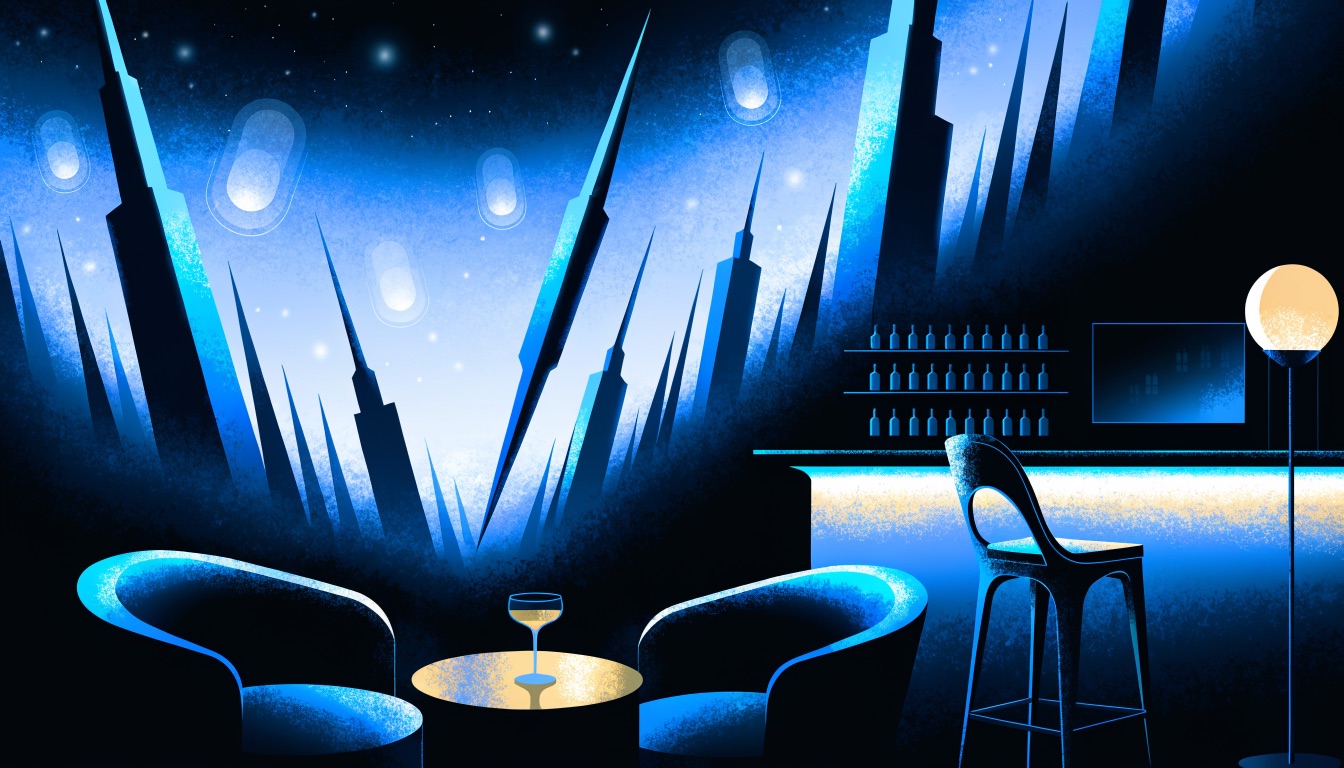
There is a seat at the end of the bar at Venetian Soda Lounge that gets the best view in the room. From it you can see the stage, the front door, the back bar, and the shelf where the strange objects live. What follows is a scene from that seat, and I want to be straight with you about what it is: a composite, staged the way I would stage a film scene, because that is how my brain works. No single guest. No invented dialogue. But every object in the scene is real, and most of them are real because I made them.
A Tuesday night in February. Burlington, Vermont, which in February really commits to the bit: snow ticking sideways against the windows, every person arriving in the doorway looking personally betrayed by the weather. Inside, the light is low and amber. A musician is running a soundcheck, playing half a verse of something, stopping, adjusting a mic stand, playing it again. There is the specific hush of a room that has not filled up yet. A guest takes the good seat, orders, and then does the thing people do while a drink is being made, which is nothing. Ninety seconds of nothing. In this era, those ninety seconds belong to a phone by default. The phone has an enormous head start and a marketing budget.
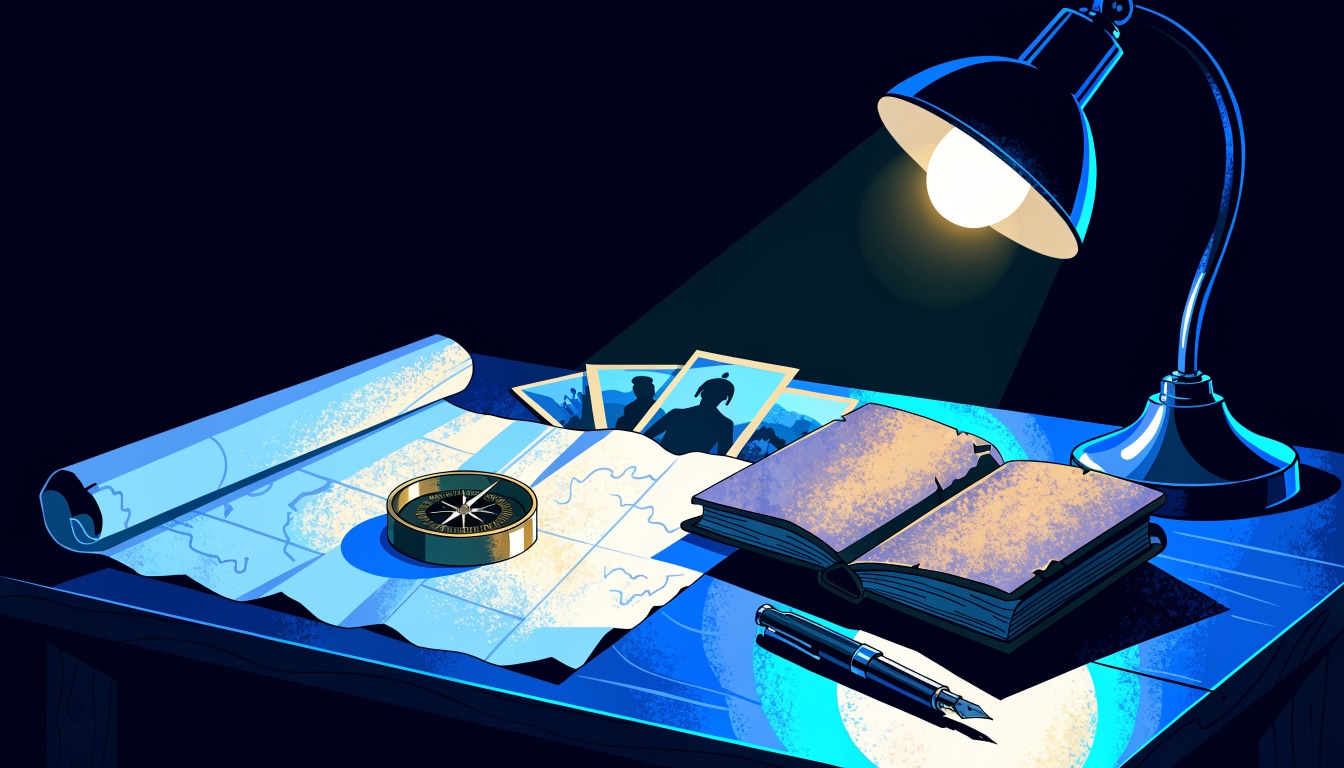
But the shelf gets there first. Under glass: a field journal, open to a page of dense handwriting, with a sketch in the margin of something that might be a temple and might be a mountain, depending on how you squint. Behind it, a map, creased the way maps get when they have been folded and refolded by somebody who actually needed them, a route inked across it in a confident hand, an expedition stamp, a date that does not belong to this century. A photograph. A letter that looks like it survived something. None of it is labeled. There is no little placard explaining what you are looking at, because placards are how museums say you may look but you may not wonder.
The guest leans in. You can watch the question arrive, because it is the exact question the shelf was built to provoke: what is this doing in a soda lounge in Vermont?
The drink lands. She asks the bartender about the journal. And here is the hinge of the entire scene: the bartender does not shrug. The bartender answers the way you answer a question that has an answer. There is a name, Rufus Hightower. There is a story attached to the name, and the story has edges, dates, unfinished business. The bartender knows a piece of it, gestures at the existence of more, and moves down the bar, because there are other tickets and the mythology is never allowed to hold up a drink order.
My favorite part happens after she leaves, and it is the part I am proudest of. The name works. Pull on it at home and a trail appears: expedition materials, fragments of a documented history, a playable web demo, an interactive case-file mystery called SodaBarVT that takes place in the same universe as the room she was just sitting in. The thread she started pulling at the bar keeps going after the coat goes back on. It does not hit a wall.
A reasonable person, hearing that an independent bar in Vermont has an original pulp-adventure IP living underneath it, complete with a fictional explorer, lore documents, expedition dossiers, themed live events, and a playable demo, would ask why. It is a fair question. I ask myself a version of it during inventory.
The short answer is that I built Rufus Hightower because branding was not enough.
The longer answer is this essay.
The eight-week brand
Here is what a brand identity is, in the standard package. A logo. A typographic system. A color palette. A voice guide. A slogan. A folder of social templates. Hire a good agency and you will have an excellent version of all of it in about eight weeks, and I want to be clear that none of it is wrong. Venetian has all of those things. You need them the way a film needs a poster.
The problem is not the quality of the package. The problem is what the package is. Every item in it is a surface. And a surface, in the literal sense, has nothing behind it. If a customer gets curious and starts pulling a thread, the thread ends at the color palette. Not because anybody failed. Because nobody built anything back there. Two thousand other businesses in your category bought the same eight weeks, and from a distance all of you are tastefully interchangeable.
There is another layer available, and most businesses never touch it. I think of it as mythology. Not mythology in the marketing-deck sense, where the word means the founder's garage story told with swelling music. Mythology in the older sense: the specific stories, characters, artifacts, and rituals that a place accumulates because somebody decided the place would have them.
Inside a business, mythology looks like a recurring character with a biography the staff knows better than the guests do. It looks like a history that is partly real and partly invented, surfacing in the menu, on the walls, in the programming. It looks like objects that appear to be relics of that history: journals, maps, correspondence that has been conveniently "found" and now lives under glass. It looks like rituals that only make sense inside the story, and extensions of the story into other media, so the world exists in more places than the room does.
Now read that list back and notice what it describes. It describes a theme park. Every one of those elements is load-bearing at Disneyland. Almost none of them are load-bearing in an ordinary bar or restaurant. That gap is not a law of nature. It is a habit nobody questioned, and it is exactly where the opportunity sits.
I want to be careful about lineage here, because none of this is my invention, and I get suspicious of anyone in my line of work who implies otherwise. Themed entertainment has been practicing this for seventy years. The great tiki bars were practicing it earlier than that: Don the Beachcomber opened in Hollywood in the 1930s dressed in nets, lanterns, and beachcomber salvage, an entire fictional life story implied by the objects on the walls. There is a story, repeated so often it has achieved legend status, that the owner rigged water to fall on the roof so guests would hear rain and stay for one more drink. I cannot verify it, and I choose to believe it anyway, because it is the whole discipline compressed into one image: engineer the world, and the world does the selling. Video games have been building persistent universes with lore hidden in the item descriptions for decades, quietly training a couple of generations to read environments for story. Storyworld hospitality, which is my working name for dragging all of those disciplines into an independent bar, has a long and honorable family tree. I have written about the broader practice in Storyworld Hospitality. This essay is about the character at the bottom of mine.
What the explorer actually does
Rufus Hightower is a fictional adventurer in the pulp tradition. He has a lore document that establishes who he is, where he went, and what he left unfinished. He has expedition-dossier materials, the journals and maps and correspondence from the scene above. He has themed live events at the lounge that treat guests as participants in his ongoing story rather than spectators of it. He has a playable web demo. SodaBarVT, the interactive mystery experience we built for the lounge, plays inside the same universe. None of these pieces were made separately and stapled together afterward. The world holds because it was designed to hold.
Crucially, none of this is a costume. Rufus is not a bartender in a pith helmet. The character exists at a level that supports the room without becoming the room's whole personality. A guest who has no idea Rufus exists can walk in, drink something excellent, listen to a musician play for a room that is actually listening, and go home happy. A guest who notices the shelf gets a second layer of the same night for free. The mythology rewards curiosity. It never punishes ignorance. That is the design rule underneath everything else, and I will come back to it, because breaking it is the fastest known method for ruining the whole project.
First, though, the accountant's question: why bother? Maintaining a fictional universe costs real energy, and nobody pays extra for lore. I have checked the point-of-sale reports. There is no lore line item.
Here is what the mythology actually does, in business terms.
- It gives regulars something to keep discovering. A surface brand runs out of things to notice in about two visits. A world is functionally bottomless. There is always another artifact, another reference, another event that turns out, in retrospect, to have been a chapter.
- It changes what a job is. Staff working inside a story are custodians of something, not just employees of something. When a bartender fields the who-is-this question with a real answer, service gets more interesting on both sides of the bar.
- It is a content factory that never idles. Every artifact, event, and character beat is material: photography, video, print, email. I almost never sit down to "make content." I expand the world, and the content falls off the back of the truck.
- It gives events a spine. A themed night hanging off nothing is decoration. A themed night that is a chapter in an ongoing story earns a different quality of attention, especially from people who were present for the previous chapter.
- It builds IP. This is the long game, and I hold it loosely. But a world built inside a real business can eventually extend beyond it. Rufus already lives across print, live events, and a playable demo. Bar-owner-turned-showrunner is not a standard career path. It is, however, an available one, and it starts with a world people already believe exists.
I will admit the last point is speculative and the first four are not. The discovery layer, the staff layer, the content layer, and the event layer pay rent right now, this month, in an ordinary independent business. The IP layer is a lottery ticket that costs almost nothing extra to hold, because the assets that make the business better today are the same assets that would matter if the world ever grows legs. That is the kind of bet I like: the downside is a more interesting bar.
There is also a return that never shows up in any report, and I have stopped pretending it does not matter. A business with a world underneath it is more fun to run. The days in hospitality are long. Some of them are brutal. On those days, the difference between operating a beverage program and operating a beverage program with a fictional explorer buried under it is not nothing. It is sometimes the whole difference.
Pulling the thread
The failure mode of all this is the failure mode of every nerd-adjacent hobby in existence: demanding that the audience catch up before they are allowed to enjoy the thing. If a guest has to absorb lore before they can comfortably order, you have built a very specific kind of unfriendly bar. Nobody wants to be quizzed on the way to a cocktail. The moment the mythology becomes a gate, it is doing the exact opposite of its job.
The test I use is simple, and I recommend it. If a guest ordered a drink, never noticed the fictional layer at all, and left, did they still have a great night? If yes, the mythology is behaving. If no, I have accidentally built a museum with a liquor license, and I should expect the online reviews to describe exactly that experience, because guests are precise about this sort of thing even when they do not have the vocabulary for it.
If you run something, and you are wondering whether any of this applies to whatever you run, two questions.
First: is there anything underneath your brand? When a curious customer pulls a thread, does the thread lead somewhere, or does it end at the color palette? Be honest. Most businesses have never been asked the question, which is different from having an answer.
Second: would your people be more engaged working inside a story? For more teams than you would guess, the answer is yes, and the mythology becomes an internal culture asset long before it becomes an external marketing one. People like being custodians. It is a better job description than staff.
If both answers are yes, you have room for a world. It does not need a fictional explorer. It does not need pulp, or maps, or a stamp from the wrong century. It needs to be specific, coherent, and generous, which is harder than it sounds and cheaper than you think.
Which brings me back to the guest in the good seat, because I realize, watching the scene again, that it was never really about the shelf. Look at what actually happened. A person had ninety empty seconds, and a room had prepared something better for those seconds than a phone. She noticed a detail. She leaned in. She asked a question, and the world answered instead of shrugging. For a minute and a half on a Tuesday in February, she was not a customer waiting on an order. She was the person who spots the odd detail and pulls the thread. Which is to say: for ninety seconds, the explorer in the room was not Rufus.
That is the actual product. Rufus is fictional. The curiosity is real, and it was hers, and the whole apparatus of lore documents and dossiers and stamps exists to give that curiosity somewhere to go. A brand is a billboard: you see it, you register it, you drive past. A world is a room that hands you a thread and means it.
Somewhere in Vermont tonight the snow is going sideways, a musician is tuning, and a stranger is leaning toward a shelf full of things that never technically happened. The expedition is doing its job anyway.
Related: Storyworld Hospitality, Gingy 9000: Why I Built a Robot Mascot for a 100-Year-Old Ginger Ale, The Guest Is Not the Audience. The Guest Is the Character.