Gingy 9000: Why I Built a Robot Mascot for a 100-Year-Old Ginger Ale
Respecting heritage does not require embalming it. On why a hundred-year-old ginger ale needs a robot, and why the robot works.
There is a particular face that reasonable people make, and I have become a connoisseur of it.
The setting where I know it best is a small office with carpet the color of oatmeal, a laminate conference table, and coffee from one of those pump thermoses that promises regular on one side and decaf on the other and delivers lukewarm on both. Across the table sits a man I'll call Dave. Dave works in the world of numbers: lending, accounting, the general profession of asking founders questions they should have asked themselves. Dave is technically a composite of several real people, because this exact conversation has happened more times than I can count, and everyone involved deserves anonymity for how their face behaved.
On this particular afternoon, Dave has just finished nodding along to the sane part of the presentation. Heritage beverage brand, revived after decades of dormancy. Real family history in Vermont bottling. A cocktail lounge in Burlington, open since August 2022, doing well. Live music program. Growing brand. Dave likes all of this. Dave is nodding the nod of a man who has decided you are a client and not a cautionary tale.
Then I slide a single printed page across the laminate.
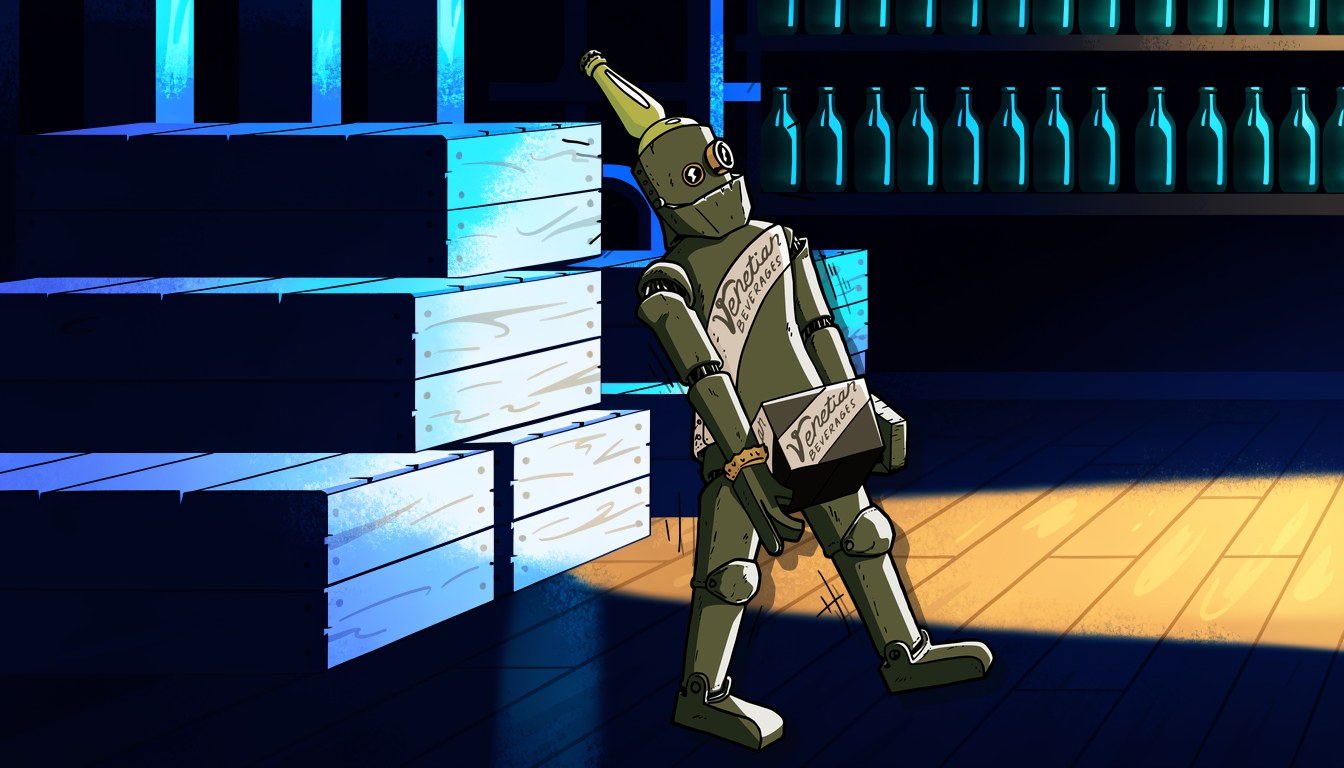
On the page is a robot. He is olive green, built like a vintage tin toy, the kind of wind-up figure you'd find at the bottom of a trunk in an attic: sturdy little body, cheerful posture, proportions that suggest he was designed by someone who loved him. On his head, worn with total confidence, is a green glass bottle. Across his chest is a sash, the kind pageant winners and parade marshals wear, and the sash says Venetian Beverages. In his arms he is carrying a wooden crate of ginger ale.
Dave looks at the page for a long time. Somewhere down the hall a copier starts up, does its work, and finishes. Dave looks up.
"This is for the ginger ale."
"Yes."
"The hundred-year-old ginger ale. From your family."
"Yes."
"It's a robot."
"His name is Gingy 9000."
Dave looks back down at the page. I watch him take in the details in order: the bottle on the head, the sash, the crate. I can tell when he reaches the sash because his eyebrows move.
"Why is he wearing a sash?"
"He's proud of the company."
A pause with real structure to it.
"The robot is carrying a crate."
"He's helping."
And there it is: the face. It's not disapproval, exactly. It's the face of a man watching two spreadsheets refuse to reconcile. Everything else in the folder says steward of a serious family legacy. The page in his hand says tin robot with a bottle hat. Dave's face is asking the entirely reasonable question, and I have learned to love the question, because I think the answer is the most useful thing I know about heritage brands.
This essay is the long version of what I said to Dave.
The tasteful option is a museum
Let's start with what I was supposed to do, because the correct answer was never a secret. On paper, the right mascot for a hundred-year-old Vermont ginger ale is a bearded man in a period-appropriate vest, holding an oversized bottle and staring into the middle distance with the confidence of a man who has never had a modern conversation. That is what a design agency would propose. That is what the heritage-branding playbook recommends. That is what a great many tasteful, handsome, completely forgettable heritage products actually do.
The playbook is well understood, and every element of it is defensible on its own. Sepia photography, because the past was apparently beige. Period typography, lovingly restored. A reverent brand voice that sounds like it's holding its breath out of respect for the ancestors. Reproductions of the old labels, handled like relics, because they are.
I understand the appeal, and I want to be fair to it: I had the archive in my hands. The old Venetian bottles and labels are genuinely beautiful, and there was a version of this project that simply framed them. Nobody would have criticized it. That's actually the problem. The tasteful option is the option nobody criticizes, and things nobody criticizes are usually things nobody remembers either.
Because collectively, those defensible choices add up to a museum, and a museum has a very specific commercial ceiling. People visit a museum once. They walk through respectfully, they say lovely, and they do not drink one on a Friday night.
The tasteful option also does something quieter and worse. It announces that the brand's best days are behind it. Preserved artifact. Handle with care. Consume with appropriate reverence. Every sepia photograph whispers it: the important part already happened, and you missed it. That is a strange and self-defeating thing to say about a beverage a customer is deciding whether to buy on an ordinary Wednesday. Heritage that reads as historical isn't a competitive advantage. It's a period costume, and the customer can tell it's a costume, because costumes don't sweat.
So the real question was never whether to honor the history. The history is the entire reason any of this exists. The question was what vehicle could carry a century-old story into a room full of living people and have them actually want to spend time with it.
Which brings me to the best precedent I know, and it involves a more famous robot.
A robot Lincoln walks into a World's Fair
In the early 1960s, Walt Disney put an enormous amount of money, engineering, and personal obsession into building a mechanical Abraham Lincoln.
It's worth sitting with how insane that sounded at the time. The most revered figure in American history, a man with a temple in Washington and a face on the currency, and Disney's plan for honoring him was, essentially, an animatronic figure that would stand up in front of a live audience and deliver Lincoln's own words: a robot, built by the theme park man, playing the sixteenth president. Plenty of serious people found the whole idea somewhere between absurd and disrespectful. You could practically hear the tasteful option clearing its throat: surely a statue, a portrait, a solemn film. Something dignified.
Disney built the robot. It debuted at the 1964 World's Fair in New York, in the Illinois pavilion, and the thing about it that nobody expected was what happened in the seats. Audiences didn't smirk. They went quiet. The figure rose, spoke, gestured, and grown adults who had walked in ready to be amused reportedly walked out having been moved, some of them through tears. The mechanical Lincoln became one of the most beloved things Disney ever made, and versions of it have been performing for over half a century since.
Here's what I take from that, and why I keep it close. The dignified option for honoring Lincoln already existed. It was a statue. There were plenty. Statues are the sepia photographs of statesmen: accurate, respectful, and inert. What Disney understood is that reverence is not the only way to honor the past, and it is rarely the most effective one. Wonder is a delivery system. The robot looked undignified on paper and then carried more genuine feeling into that room than any oil painting could have, because it did the one thing the past is never supposed to do. It stood up and spoke to you.
The vehicle was absurd. The cargo arrived intact. That's the whole trick.
I want to be clear that I am not comparing my ginger ale robot to the Great Emancipator, mostly because Gingy would find the pressure unbearable. The point is the mechanism, and the mechanism scales down beautifully. The question is never whether the vehicle is dignified. The question is whether the vehicle delivers the heritage alive.
What the robot is actually doing
So: Gingy 9000. Olive green, tin-toy proportions, green glass bottle on his head, Venetian Beverages sash across his chest, crate of ginger ale in his arms. A robot who is very enthusiastic about ginger ale, which is not a sentence that appears in any serious heritage-branding document, and that's rather the point.
Start with the design, because none of it is arbitrary. Gingy is built like a vintage tin toy on purpose. He isn't a sleek chrome android or a cartoon blob; he looks like something manufactured decades ago, wound up, and never quite allowed to run down. Which makes him, in a sideways way, more honest about the brand's actual history than the bearded founder would be. The stern man in the vest pretends the dormancy never happened, that the brand marched unbroken from then to now. Gingy embodies the real arc: an old, well-made thing from the attic that woke back up and got to work. He looks like the era the brand slept through. He is heritage-shaped. He just refuses to be solemn about it.
The bottle on his head is the product, worn like a crown by someone with no concept of embarrassment. The sash is pure earnest institutional pride, the kind you'd see on a parade marshal in a small-town Fourth of July photograph from the archive. And the crate matters most of all, because the crate means he's working. He is not posing for a portrait. He's mid-delivery. A mascot who carries things is a mascot from a business that still moves product, and if you've read The Strange History Behind Venetian, you'll recognize that this is the same argument as the old deposit bottles: the heritage objects were never monuments, they were working equipment. Gingy carries the crate because the brand is still in motion. He's helping.
Beyond the design, the character earns his keep mechanically, in ways the bearded man never could. He gives the brand a face that isn't a founder, and that distinction is everything: a founder-portrait mascot is a memorial, while a character is a living entity, and every time Gingy shows up the brand looks like it's being made now, by people enjoying themselves. He gives the brand permission to be funny, which heritage brands almost never grant themselves, and which extends the voice's range enormously. He's a content and merchandise engine in a way no historical portrait can be: you can put Gingy on a shirt, a poster, a coaster, a sticker, a limited can, and none of it feels strange, whereas a stern ancestral portrait on a coaster feels like drinking on someone's grave. He opens a door for people who could not care less about Vermont bottling history, and there are many such people, and they are allowed in the room too; the character is an entrance that the history alone never opens. And he carries the mythology: Gingy lives in the same universe as Venetian and Rufus Hightower and the larger storyworld, a chapter in a coherent world rather than a standalone gag, which makes him more valuable every year instead of less.
The deliberate absurdity is the load-bearing part, so let me defend it directly. The instinct to make a heritage mascot dignified is strong, and it is a bad instinct. Dignified mascots do not survive, because nobody wants to spend time with one. The characters people voluntarily spend time with are brave, funny, weird, or beloved. Dignified is not on the list. Dignified is a lobby portrait. Making Gingy absurd, and specifically making him sincerely, unselfconsciously absurd (he is not in on the joke; he genuinely loves the company), was a decision to give the whole brand permission to smile at itself. Brands that can laugh at themselves get laughed with. Brands that can't become the dinner guest who keeps explaining how important their family used to be.
I do hear the counterargument, usually from people with excellent taste. Gingy is undignified. The brand deserves better. The family history is being reduced to a joke. I take it seriously, because for a while it was my own voice saying it, at one in the morning, in the empty lounge; I've written about whose voice that actually was in Trying to Impress Ghosts. But the answer holds. Dignified brands die quietly. And the history is not being reduced. It's being extended. The archive is intact, handled with care, and anyone who wants the real story can have all of it. The robot is not a replacement for the heritage. He's a translation layer: the history is the foundation, Gingy is the tour guide, and they are doing different jobs. Heritage brands that fail almost always fail by refusing to translate, staying in the language of their founding era on the theory that authenticity requires it, while customers correctly read the whole performance as this brand does not know how to talk to me. The brands that make it across a century keep the truth intact and give it a living voice.
The version of Venetian that would have made everyone comfortable is a version nobody would remember visiting. Those are the actual stakes. Comfort now, silence later.
And because he's a character rather than a campaign, Gingy compounds. He shows up in physical form at events, in graphics, in social content, always the same person: enthusiastic, warm, a little strange, devoted to ginger ale for reasons he has never once questioned. Consistency is the whole asset. A mascot that arrives the same way every time accumulates meaning the way the embossed bottles accumulated it, one appearance at a time, for years. Campaigns evaporate. Characters accumulate. If you run a heritage brand and you take nothing else from this essay, take that: don't hire a rebrand, cast a character. Yours doesn't need to be a robot. A raccoon in a sailor's cap. A talking steamer trunk. A fictional detective who drinks nothing but your product. It only has to be specific, consistent, warm, and allowed to be funny.
The dignified version is always available. It just isn't a business strategy. It's a taxidermy strategy.
Which brings me back to the oatmeal carpet, and Dave.
At the end of that first meeting, after the questions about margins and the questions about distribution, Dave picked up the page with the robot on it one more time. He looked at the bottle hat. He looked at the sash. He was quiet for a moment, and then he slid it back across the laminate with the tone of a man surrendering to something he had decided not to name.
"My kid would love this."
Which was the whole argument, made better than I'd made it in twenty minutes of talking. Not: this honors your great-great-grandfather's legacy. Not: this preserves the archival integrity of the brand. Just: a living person, who has never heard of anyone in my family and never will, would love this. Would want the sticker. Would ask questions. Would, years from now, maybe order the ginger ale because of a green robot they liked when they were nine, and then, maybe, ask where the name Venetian came from. The door opens, and the history is standing right behind it, intact, patient, finally being asked about.
That's what the reasonable face never sees coming: the robot was the serious option all along.
He's olive green. He wears the company sash. He's carrying the crate.
He's helping.
Related: The Strange History Behind Venetian, Rufus Hightower and the Case for Giving a Business Its Own Mythology, Storyworld Hospitality.