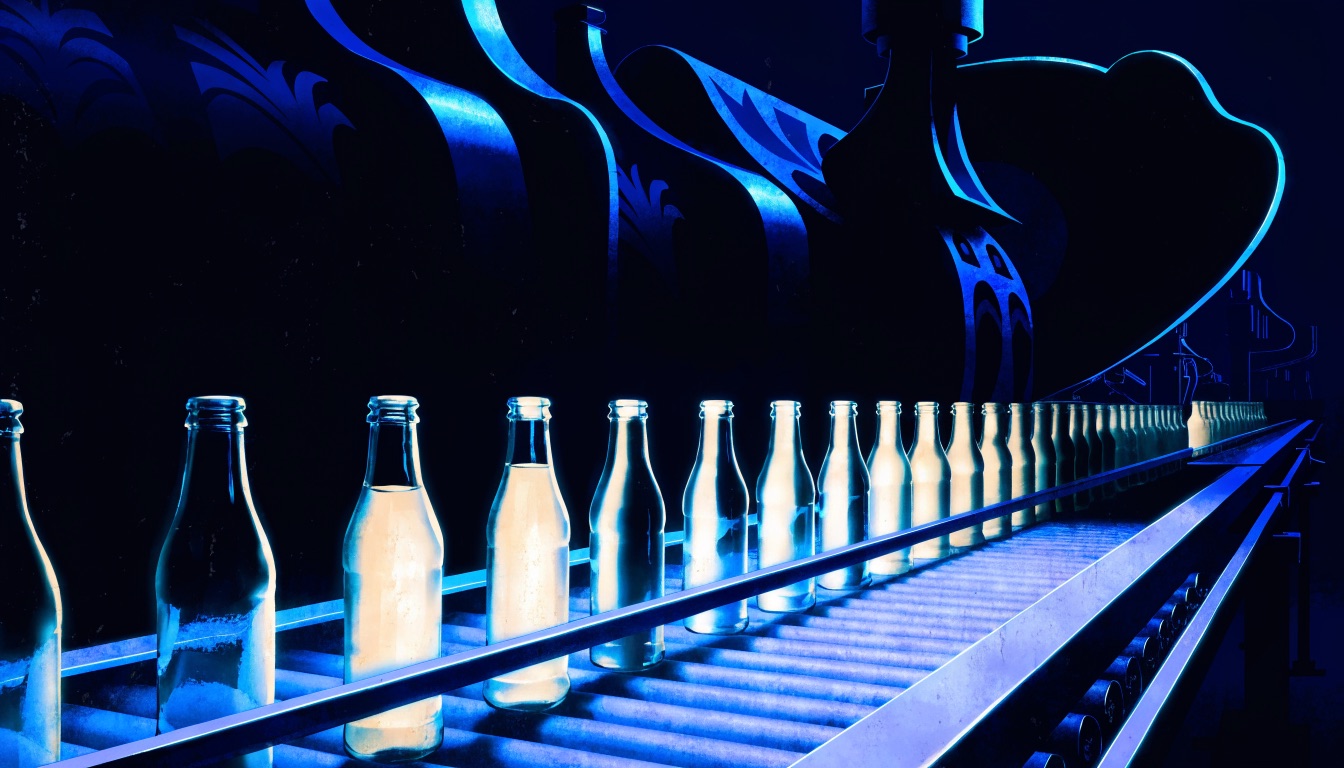
From Coca-Cola Bottlers to Cocktail Lounge: The Strange History Behind Venetian
An old embossed bottle, a dormant family brand, and the specific gravity of being handed a story. A note on heritage as an asset, and heritage as a leash.
There's a bottle on my desk while I write this. It's about nine inches tall, green glass, and heavier than a bottle has any right to be, with most of the weight sitting low in a thick slab of a base, as if the person who designed it was mostly worried about it tipping over on a delivery truck. It leans, very slightly, to the left. Somewhere in the last hundred years it either got tired or was born that way, and there is nobody left to ask.
Hold it up to the lamp and the color shifts from nearly black at the base to a bright bottle-green at the shoulder, and you can see tiny bubbles suspended in the glass, frozen mid-rise. They have been on their way to the surface since before my grandparents were born. They are not going to make it. There's something about that I find almost unbearably good: a hundred-year-old object still visibly in the middle of doing something.
Around the shoulder, pressed into the glass itself, it says VENETIAN.
Not printed. Not painted. Not a paper label that could soak off in a sink or bleach out in a shop window. Embossed, which means somebody paid for a mold with the family brand cut into it, which means removing the name from this object would require breaking the object. Paper labels were cheaper. Embossing was a commitment. Somebody made that choice on purpose, and I think about it more than I'd like to admit.
Run a thumb over the letters and you can feel the seams where the two halves of the mold came together, faint ridges climbing the sides like old scars. The glass stays cool even in a warm room. Old bottles are always cool. I'm sure there's a physics explanation and I have decided not to look it up, because some details are better left as details.
It came to me the way most of the Venetian archive came to me: in a box that smelled like a basement, packed alongside old labels and paper ephemera that I handled the way you handle things that cannot be replaced, which is to say badly at first, and then with increasing paranoia.
Here's the part that gets me, though. The person who filled this bottle never looked at it twice. It came down a line in a Vermont bottling operation on some ordinary weekday, one of thousands that month, and got filled, capped, crated, and sent out into Burlington to do its job. It was packaging. More than that, it was a deposit bottle, which means it wasn't even supposed to be kept. It was designed to leave, get emptied, and come home again. Nobody who touched it ever thought the word heirloom. If you could have told the man on that line that a descendant of the owners would one day keep this exact bottle on a desk and stare at it while trying to write honestly about the family business, he would have had questions, starting with why, and moving quickly to what happened to the business.
And yet here it is. The plant is gone. The trucks are gone. The men whose names were on the paperwork are gone. The century that swallowed all of it is gone. The single most disposable object in the entire operation is the one that made it out.
Sometimes I pick the bottle up and there's a question inside it, the way there's a ship inside those other bottles. The question is not, isn't this nice. The question is: what exactly do you think you're going to do about this?
I ended up being the person who restarted the story this bottle came from. I want to tell that story properly, which means telling you up front that parts of it are still missing, and that I'm not going to fill the gaps with confident guessing. The seams are going to show. Like the bottle, I've decided to let them.
What I actually know
The heritage behind Venetian is real. Vermont has a long history of independent bottling operations, and Burlington in particular had a beverage economy that predates most of what people currently associate with the city. In the early twentieth century, soda wasn't a national industry with local outposts. It was a local industry that occasionally had national names attached to it. Coca-Cola in that era was less a monolith than a constellation: hundreds of small, family-run bottling houses across the country, each with its own territory, its own trucks, its own handshake relationship with every store owner in town. And because the equipment didn't especially care what you ran through it, those local bottlers very often made their own flavors alongside the franchise product. A ginger ale here, a birch beer there. House brands, with the family's own name on the glass.
Somewhere inside that world is my family. Specifically, the story connects M.C. Dorn, S. Lee Kilburn, a Coca-Cola bottling operation in Vermont, and a ginger ale that carried the Venetian name.
[JUSTIN: VERIFY / EXPAND: the specific dates, the exact ownership structure, and the relationship between the Coca-Cola bottling side of the business and the Venetian Ginger Ale side. I want to say this with more precision than I currently can from public sources. Anything about the years the operation was active, the year Venetian Ginger Ale first appeared, and the point at which it went dormant would ground this section considerably.]
What I can say with confidence is what was in the box. By the time the story reached me, Venetian was a dormant brand with a real archive behind it. Old bottles, including the one on the desk. Old labels. A family memory of a real operation that had been part of the city's beverage economy for a long time. That was the raw material I inherited. Not a going concern. A story with the lights off.
Dormancy is a strange fate for a brand, stranger than death in some ways. Nobody killed Venetian. There was no dramatic collapse, no scandal, no fire sale that I know of. It just stopped, the way things stop: the market moved, the people moved on, and at some point nobody was making ginger ale with the family name on it anymore, and then that particular nothing repeated itself for decades. Death at least gets a date on a stone. Dormancy just gets quieter until someone either notices or doesn't.
I noticed. A handful of years before the lounge existed, I picked the brand back up and started making Venetian Ginger Ale again. [JUSTIN: VERIFY the exact year if we ever want to state it precisely; the revival was around 2017 to 2019.] Compressed into one sentence like that, it sounds like a clean decision made by a confident person. It was neither. Because the first thing you learn when you're handed a piece of family history is that it weighs more than it should.
A dormant brand is not really an asset. It's an obligation with good typography. Somebody who was here before you cared about this. You didn't invent it. You didn't build the operation the first time. You're inheriting the emotional weight of whatever it meant to them, and if you do nothing with it, the whole story quietly ends on your watch. That is a very specific kind of pressure, and it does not behave like normal entrepreneurial pressure, which is mostly about money and markets and the reasonable fear of public embarrassment. Heritage pressure is about ancestors. Which means it's about ego, guilt, love, ambition, and the deeply unrealistic idea that you can retroactively make somebody proud of you who has been dead for a long time.
I've written about that psychological side at length in Trying to Impress Ghosts, and I'd send you there for the full excavation. This essay is about the business question, which turned out to be strange enough on its own: what do you actually do with a name that was already known before you were born?
A foundation or a costume
There are two things you can do with a dormant heritage brand, and the industry default is the wrong one.
The default is to treat the heritage as a marketing story. Sepia photographs. Vintage typefaces. Testimonial-style copy about how it was made back in 1912, set in a font that costs extra. This works, sort of. It photographs beautifully, and nobody ever gets fired for recommending it. It is also a museum, and a museum is a place people visit once. They walk through respectfully, they say lovely, and they do not come back on Tuesday.
The other option is to treat the heritage as a foundation. Use the real history to earn a specific point of view about beverages, hospitality, and craft, and then build something unmistakably contemporary on top of it. Let the past hold the building up instead of decorating the windows.
The Venetian I've built is deliberately the second version. In August 2022 we opened Venetian Soda Lounge in Burlington: a cocktail lounge sitting on top of a beverage brand, which is itself sitting on top of a century of Vermont bottling history. The room references its era. The drinks reference the history. The brand voice knows the family story cold. But the guest walking in on a random Thursday is not visiting a diorama. They're walking into a room that is alive right now, with live music and craft cocktails a person today actually wants to drink, while the hundred-plus years underneath the floor do their work silently, the way a foundation is supposed to.
Here's the test I run, and it's clarifying mostly because it's a little brutal. Almost none of our guests have ever heard of M.C. Dorn or S. Lee Kilburn. They don't know about the Coca-Cola connection. They don't care about the timeline, and they are completely right not to, because they came out tonight for a good drink and a good room, which is the correct reason to visit a bar. If the heritage story ever becomes required reading, I've done my job badly. If the heritage is quietly making the drinks better, the room stronger, and the night more textured without the guest ever having to know why, I've done my job well. The history should sit in a guest's peripheral vision. If a curious person asks, the whole story is there waiting for them. If a casual person never asks, the room still works.
So the rule I try to operate by, imperfectly: preserve the parts of the history that make the current experience better, and break from the parts that make it worse. A ginger ale recipe worth respecting: preserve. Old labels worth quoting on the current packaging: preserve. The naming that connects the new brand to the old one: preserve. Old-timey typography as the entire visual system: break. Sepia as the ruling aesthetic: break. A menu that reads like it's trapped in 1922: break, gently, with apologies to 1922.
The strange thing is that the second path is much harder than the first, which is probably why the first one stays so popular. Anybody can hire a design agency to make a heritage brand look tasteful. Making a heritage brand feel alive is a different problem entirely, and there is no way to find out whether you're getting it right except to run a real room full of real people, night after night, and watch what they do.
This is also, for the record, why there's a robot. The heritage story is the reason Gingy 9000 exists: an olive-green robot built like a vintage tin toy, with a green glass bottle perched on his head, a Venetian Beverages sash across his chest, and a crate of ginger ale in his arms that he carries around like it's his entire purpose in life, because it is. On paper, the mascot for a hundred-year-old ginger ale should be a stern bearded man in a period vest. In practice, that man is a museum docent, and Gingy is what happens when you decide the heritage is a foundation instead of a costume: a character who can talk about the history without being embalmed in it. That decision earned its own essay, Gingy 9000: Why I Built a Robot Mascot for a 100-Year-Old Ginger Ale, because the reasoning needed more room than a paragraph.
Underneath all of it sits a distinction I keep coming back to: inheriting a story is not the same as being trusted with one. Anybody can inherit a story. It arrives whether you're ready or not, in a box that smells like a basement. Being trusted with it is something you have to earn afterward, from the living, one night at a time. The whole shape of Venetian, from the ginger ale to the lounge to the surrounding creative projects, is my ongoing attempt to earn that trust. Treating the story seriously, which is not the same thing as treating it solemnly. Solemn is easy. Serious means being willing to change it.
The bottle was never a monument
Which brings me back to the desk.
For a long time I looked at the embossed bottle as a relic: an object from the vanished past whose job was to sit there being meaningful. Then I learned the actual reason bottlers embossed their names into the glass, and it quietly rearranged everything.
Embossing wasn't sentiment. It was logistics. Glass was expensive, so bottles went out full and were expected to come back empty, over and over, for years. The deposit system existed to enforce exactly that. A bottler pressed his name into the glass at least in part so there would be no argument about whose bottle it was and where it belonged when it turned up across town. The name on the shoulder isn't a monument. It's a return address.
Which means the object on my desk was never asking to be admired. Every physical decision in it assumes a future. The thick base is for surviving truck beds. The heavy walls are for surviving reuse. The embossed name is for coming home. This bottle was made by a business that expected to still exist, and it was built not to be kept but to keep moving.
So the question inside the bottle turns out to have had its answer pressed into the glass the whole time. What do I think I'm going to do about this? Keep it circulating. A bottle on a shelf is a museum. A bottle in a hand is a business. The story stays alive the only way it was ever alive: by going out into the city, getting used, and coming back home.
The room does the answering now, every night the lounge is open. Every guest is a small vote on whether this story is still worth telling, and so far they keep voting yes, which is the only real evidence I have that any of this is working. And someday, if the votes keep landing, somebody I will never meet is going to hold some object from my era of this brand, feel the weight of it, notice a seam or a lean or a choice I made on an ordinary weekday without a second thought, and have to decide what to do about it. I hope the story is still moving fast enough by then that they don't have to restart it. Restarting, I can tell them from experience, is the expensive part.
The bottle stays on the desk, by the way. Not the shelf. The shelf is where you put things that are finished.
Related: Trying to Impress Ghosts, Gingy 9000: Why I Built a Robot Mascot for a 100-Year-Old Ginger Ale, and Storyworld Hospitality.