The Experience Economy Is Becoming the Human Experience Economy
As AI makes information, images, and software increasingly abundant, the things it can't cheaply reproduce may become the most valuable business assets in the room.
A Tuesday night at Venetian, not especially busy, and I'm watching two shots that belong in the same scene.
Shot one: the end of the bar. A guy, maybe thirty, alone, phone held at the exact angle the human arm has evolved to hold it. His thumb moves in that small, practiced flick, once every couple of seconds, metronome-steady. The screen paints his face blue, then warm, then blue again as the feed changes its mind about what he wants. And the feed is trying so hard. In the ninety seconds I watch, his thumb passes a comedian, some kind of astonishing drone footage, a man deep-frying something that should not be deep-fried, a war, a kitten, and a fellow explaining, with total confidence, how to get rich. Every one of those clips was engineered by professionals, or lately by machines, to be the most interesting thing he's ever seen. His expression does not change once. It is the face of a man waiting for a bus.
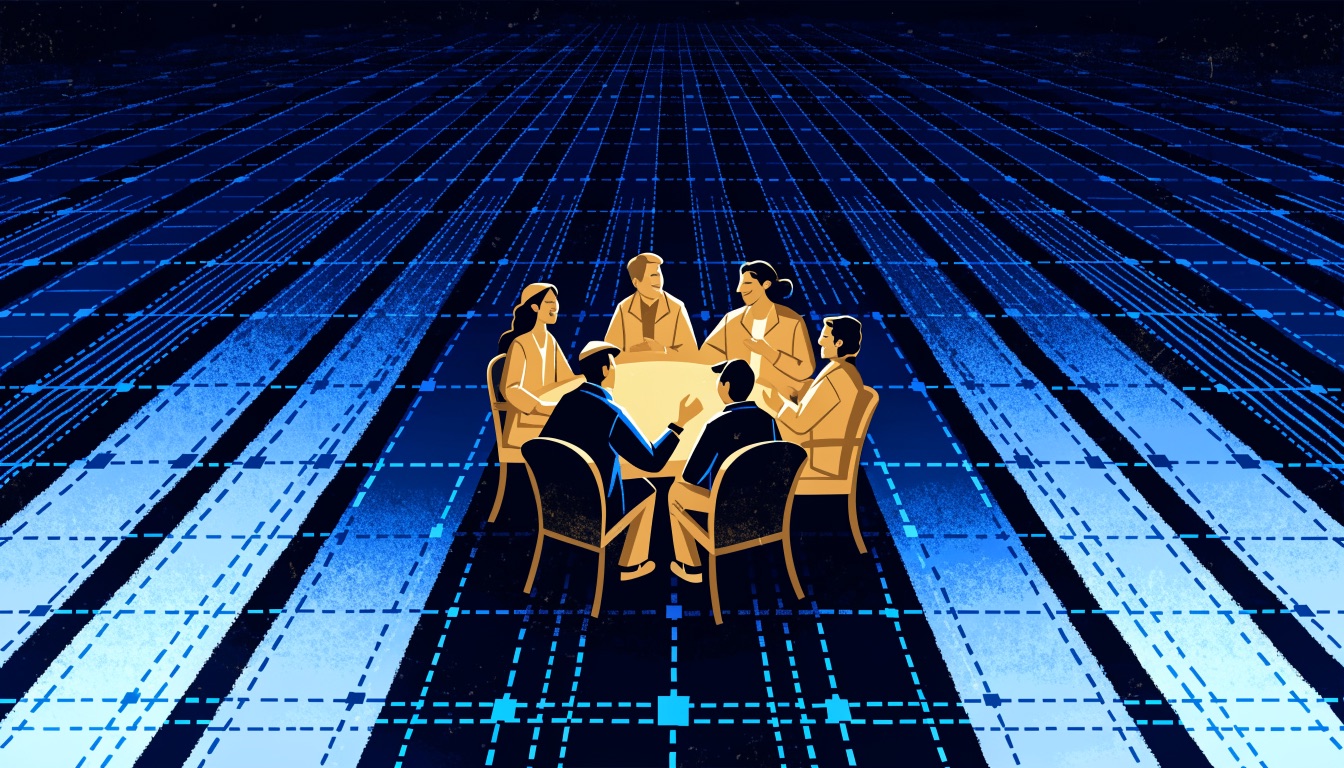
Shot two: twelve feet away, a table of six. One of the women is telling a story, and she's telling it badly, which is somehow better. She keeps backing up to add context she forgot, and her friends keep heckling the context. She starts laughing before the ending, tries to hold it, loses. The ending, when it finally staggers out, barely qualifies as an ending. The table detonates anyway. One guy does the silent wheeze and has to put a hand flat on the table like he's bracing against weather. A woman wipes her eyes with the back of her wrist, says something I can't hear, and sets the whole table off again, the second wave bigger than the first, the way second waves are.
Twenty years of editing means I can't watch two shots like that without cutting them together, and the cut is brutal. The phone in that man's hand holds more entertainment than existed on Earth in 1998. More films than any video store, more music than any record store, more of everything than any emperor ever commissioned. Effectively infinite, essentially free, refilling faster than he can drain it. And twelve feet away, six people are extracting visible joy from a resource with none of those properties: one badly told story, available in an edition of one, at this table, tonight only. It can't be paused, scaled, personalized, or recommended to him based on his viewing history. He can't have it at all, actually. You had to be there.
One of those two things is getting exponentially more abundant every year I stay in business. The other is not. I've been chewing on that difference for a while now, and I've come to think it might be the most important business question I know how to ask. What follows is a working hypothesis. I'm a bar owner with a film background, not an economist, so calibrate accordingly. But I'm running my next decade on it, so I'm at least sincere.
The ladder
In 1998, B. Joseph Pine II and James H. Gilmore published a piece in Harvard Business Review, and then a book, called The Experience Economy. Their argument was that economic value keeps climbing a ladder: from commodities, to goods, to services, to experiences. Coffee beans are a commodity worth pennies. A bag of roasted coffee is a good worth a few dollars. A cup of coffee brought to your table is a service worth a few dollars more. And a cup of coffee inside a room that feels like nowhere else on earth is an experience, worth whatever the room can honestly command. A business that could stage a memorable experience around its product, they argued, could charge a premium and build a moat.
Twenty-some years later, this is barely an argument anymore. It's the water. It's the reason your barista wears a leather apron. Everyone from airlines to dentists talks about the customer experience, mostly without meaning anything by it, which is what happens to every good idea eventually.
The framework held up remarkably well for two and a half decades. My hypothesis is that a new pressure is starting to bend it, and the pressure comes from an unexpected direction: AI is making an enormous category of things abruptly, dramatically cheaper. And when one side of an economy becomes abundant, the interesting question is never the abundant side. It's what stayed scarce.
What got cheap and what didn't
Look at what AI is currently making more abundant, and notice that the list would have sounded like science fiction the year Pine and Gilmore were writing. Information: any question, answered well enough, in real time. Images: any visual concept, prototyped in seconds. Writing: any first draft, in minutes. Software: any idea, running as a working demo by the end of the day. Recommendations, personalizations, translations, summaries, variations, all of it on tap, all of it compounding. You can quibble with the quality of any single item, and people enthusiastically do. Fine. Quibble. The trajectory is not in question. Every one of those curves points the same direction: more, faster, cheaper, everywhere.
Basic economic intuition, the kind you don't need a degree for, says that when the supply of something explodes, its unit value falls. And the things that don't scale the same way become relatively more valuable. Not because they got better. They didn't change at all. Everything around them got cheaper, and scarcity is always relative. The candle didn't improve the year the lightbulb arrived, but a candlelit dinner eventually came to mean something it had never meant when candles were simply how you saw your food.
So here's the question I think every business that touches human beings should be asking: what doesn't AI make abundant?
I keep a running list. It's short, and I notice that almost everything on it is hospitality's home turf.
- Genuine attention. One specific person actually attending to another specific person for a stretch of time. AI doesn't make this cheaper. If anything it makes it rarer, because it competes for the same finite pool.
- Physical presence. Being in a room that has texture, with other bodies in it. Not simulated presence. The actual kind.
- Recognition. Not "the system knows your preferences." A human being who knows you, clocking you from across the room, saying your name.
- Trust built over time. The bartender who knows the last five years of your life. The dentist of a decade. These are the opposite of instantly provisioned.
- Belonging. The sense that a place is yours, and that walking in is a return, not an arrival.
- Craft with a visible human hand. The dish that was obviously assembled by a particular person. The room that was obviously loved by somebody.
- Shared memory. The night your table talked about something none of you will ever forget. Manufactured inside a room, by the room, unrepeatable anywhere else.
- Surprise from a human. The bartender who reads your mood and builds something that isn't on the menu. Not a recommendation. A gesture.
Every item on that list scales linearly with human labor, which is exactly why the last forty years of business orthodoxy treated them all as cost problems. And AI does not make any of them cheaper. In some cases it actively erodes them, because the same technology that summarizes your inbox and autocompletes your day is also, at the table, competing with the person across from you. The man at the end of my bar was not having a cheap experience. He was having an infinitely abundant one. That turns out to be a different thing.
I want to flag the obvious objection here, mostly because I keep making it to myself. Every new medium in history has produced somebody standing off to the side insisting the real thing is better. Theater people said it about film. Film people said it about television. Everybody said it about the internet. Mostly those people lost the argument, or at least lost the market, so maybe I'm just the newest guy in that costume, pouring sodas. The reason I don't think so, or at least the reason I'm willing to bet a decade on it, is that the previous waves made human performances cheaper to distribute, and performers adapted to the new distribution. This wave is different in kind: it makes the content itself, generated with no performer in the loop at all. When distribution got cheap, the value moved to the performance. If the performance itself becomes synthesizable, the value has to move somewhere machines can't follow. My candidate is the room.
If the hypothesis holds, everything on that list gets relatively more valuable every single year the feed gets deeper. Which would mean the experience economy is quietly becoming something more specific: a human experience economy, where the premium doesn't attach to experiences in general, most of which can now be simulated, streamed, or generated, but to the narrow subset only humans in rooms can produce.
Running a room made of scarce things
Now walk back into a hospitality business carrying that list, and the accounting changes in front of you.
Your bartender remembering a name is not overhead. It's product. Your host looking at a guest instead of a screen is not an inefficiency to engineer away. It's product. Your live music program is not an entertainment expense to be trimmed in a soft quarter. It's the reason forty people left their infinite feeds at home on a Tuesday. Your regulars, plural, who greet each other by name because they've been colliding at your bar for four years, are not merely repeat customers. They're a live demonstration of a thing no model can generate, running nightly, in public.
The tempting move right now, and I understand the temptation because the software really is remarkable, is to read the AI moment as an invitation to spend less on the human side of the business and more on the technology side. I think that's often exactly backward. The defensible move is to spend more on the things AI cannot cheaply reproduce, and to point the AI inward, at everything else, so that you can afford to. Let the machines chew through the scheduling, the inventory, the bookkeeping, the forty administrative papercuts of running a small business, and pour every recovered hour back into the parts of the operation a guest can actually feel. That's the rule from Automate the Invisible, Humanize the Visible, promoted from a daily operating habit to a business strategy. The businesses that will look strongest in ten years, on this hypothesis, are the ones automating the invisible layer aggressively and refusing, on principle, to cheapen the visible one. The weakest will be the ones that read AI purely as a labor reduction and quietly hollowed out the exact things customers were paying for. In hospitality that mistake shows up fast. In other industries it can take years to surface, which mostly makes it worse.
And this isn't only a hospitality argument. If your product is professional judgment, creative work, teaching, care, or anything else that runs on one human attending to another, you're standing on the same ground. The parts of your business that can be generated are depreciating. The parts that require a person showing up for a person are probably appreciating. It seems to me the strategy question of the next decade, for an awful lot of businesses, is simply: which of my assets are on which side of that line, and am I investing like I know?
The honest difficulty is that nothing on the scarce list shows up cleanly on a report. Attention, presence, recognition, trust, belonging, shared memory: there's no line item for any of them. They surface later, and sideways, as retention, party sizes, word of mouth, and the telltale pattern of somebody walking in on a random weekday for no reason except wanting to be in your room. I've written before about learning to measure feelings by their financial shadows, in Why Hospitality Should Change How You Feel, and I won't rehash it here, except to say the discipline matters more under this hypothesis, not less. If the scarce things are becoming the valuable things, the businesses that learn to see them will make better decisions than the businesses that only see throughput. When I opened the lounge I was operating on the sophisticated analytical framework known as a strong feeling. I've since gotten more rigorous, but only about the measurement. The feeling was right.
If any of this lands, the way to start is almost insultingly small. Sit in your own room, or your own business, as a guest, for one hour. Notice which parts of the experience are still delivered by a human being and which have been quietly outsourced to a system, and for each one, ask two questions: would the human version be better, and could I afford it if the machines took more of the back office? Then go look at the back office and ask the mirror image. That's it. That's the audit. The whole business improves roughly in proportion to how honestly you can answer.
Back to the Tuesday. Around the time the table of six ordered another round, the guy at the end of the bar put his phone face down next to his glass. I want to be careful here, because this isn't a commercial, and he did not rise, cross the room, and discover the healing power of community. He stayed exactly where he was. But he looked up, and he watched the room for a while, the table, the bartender's build, the couple arguing happily about something by the window, and he had one more drink, and his face, I noticed, had stopped waiting for the bus.
Next year, the phone will be better. Genuinely. The feed will be deeper, sharper, cheaper, tuned to him with an accuracy that should probably alarm both of us. Everything on that screen is compounding. And the table of six will not improve at all. It will still be six people and a badly told story, produced by hand, in an edition of one. On my working hypothesis, that's precisely why the table wins the decade: everything on the phone is getting more abundant, and nothing at the table is. I could be wrong about the economics. But I know which side of the room I'm building for.
Related: Automate the Invisible, Humanize the Visible, Why Hospitality Should Change How You Feel, What AI Actually Does for a Small Business Owner.