What AI Actually Does for a Small Business Owner
No grand predictions. No AGI. Just what AI is genuinely useful for inside a small operating business right now, and the specific ways it goes wrong.
Imagine a fourteen-year-old standing in a gravel driveway on a July afternoon, staring at his uncle's Mustang.
Not a rental-counter Mustang. A vintage one. The kind with a V8 that idles like it's chewing on something, a hood long enough to have its own weather system, and paint that gets waxed with more discipline than most people apply to their retirement planning. The kid has wanted to drive this car for two years. Wanted is the wrong word. He has conducted a campaign: hints, chores, strategic loitering near the garage door.
And today, for reasons the uncle will never adequately explain, the answer is yes.
There's a dirt road out past the last fence line, flat and empty, with nothing to hit for half a mile in any direction, which will turn out to be the most important detail in this story. The uncle folds himself into the passenger seat and hands over the keys like a man handing over something ordinary, which is its own kind of genius. The kid adjusts the seat with enormous ceremony. He checks the mirrors of a car currently parked on a road with no other cars, no pedestrians, and one visible cow.
Then he turns the key, and the car wakes up underneath him, and he understands something instantly that no amount of watching ever taught him: everything he knows about driving came from the passenger seat. Which is to say, he knows nothing.
He eases out. Ten miles an hour. Fifteen. The steering is heavier than he expected and alive in a way the family sedan never was. For a hundred yards he is, in his own estimation, a natural. A prodigy, honestly. It's a shame, he thinks, that whoever scouts for this sort of thing isn't here to see it.
And then, because he is fourteen, he floors it.
What happens next takes about a second and a half. The engine goes from a rumble to a roar, the rear tires spin, gravel fires off the fenders like popcorn, and the back end of the car steps sideways with the casual violence of a large animal deciding to leave. The rear of the car is now headed somewhere the front end never agreed to. The kid does everything wrong simultaneously, which at that speed is remarkably easy, and the whole event concludes with the car stalled and diagonal in a fog of its own dust, one wheel flirting with the ditch, engine ticking like a disappointed clock.
Silence. Dust drifts across that long hood. The kid's hands are still welded to the wheel at ten and two, which is the only textbook thing that has happened so far. Somewhere nearby, presumably, the cow is unimpressed.
And the uncle, who has not moved, who may not have blinked, says in a voice with no panic in it at all:
"Now let me teach you how to drive."
Not "get out." Not "I knew this was a mistake." Not a lecture on the physics of rear-wheel drive delivered at volume. Just that. Apparently handing a fourteen-year-old the keys to a V8 muscle car is not technically considered a driver's education curriculum, but as a lesson it has never been improved on, which is why I've told it to you even though I made it up.
Because here's what the scene actually says. The kid's problem was never access to power. He was sitting inside more power than he knew what to do with. What he lacked was judgment, and the only things that convert power into judgment are teaching, humility, and a stretch of road where the mistakes are cheap. Possessing a powerful tool is not the same as knowing how to use it.
I've been thinking about that imaginary dirt road constantly for the past few years, because right now every small business owner I know is that kid, and the Mustang is AI.
The AI conversation, at the level of the average LinkedIn feed, is not designed for a person who runs a small business. It's designed by consultants, for enterprises with the budget for a chief AI officer, an implementation partner, and a Q4 initiative with its own logo. The rest of us are apparently supposed to nod along and figure out later whether any of it applies to a Tuesday.
So this is the essay I wish someone had handed me three years ago. I run a soda lounge in Burlington, Vermont, and a creative studio I started in 2009, which means I'm not writing from a conference stage. I'm writing from the driver's seat, still lightly dusted. No predictions, no AGI, no synergies. Just what the machine actually does inside a small operating business, and the specific ways it will put you in the ditch.
Learning the pedals
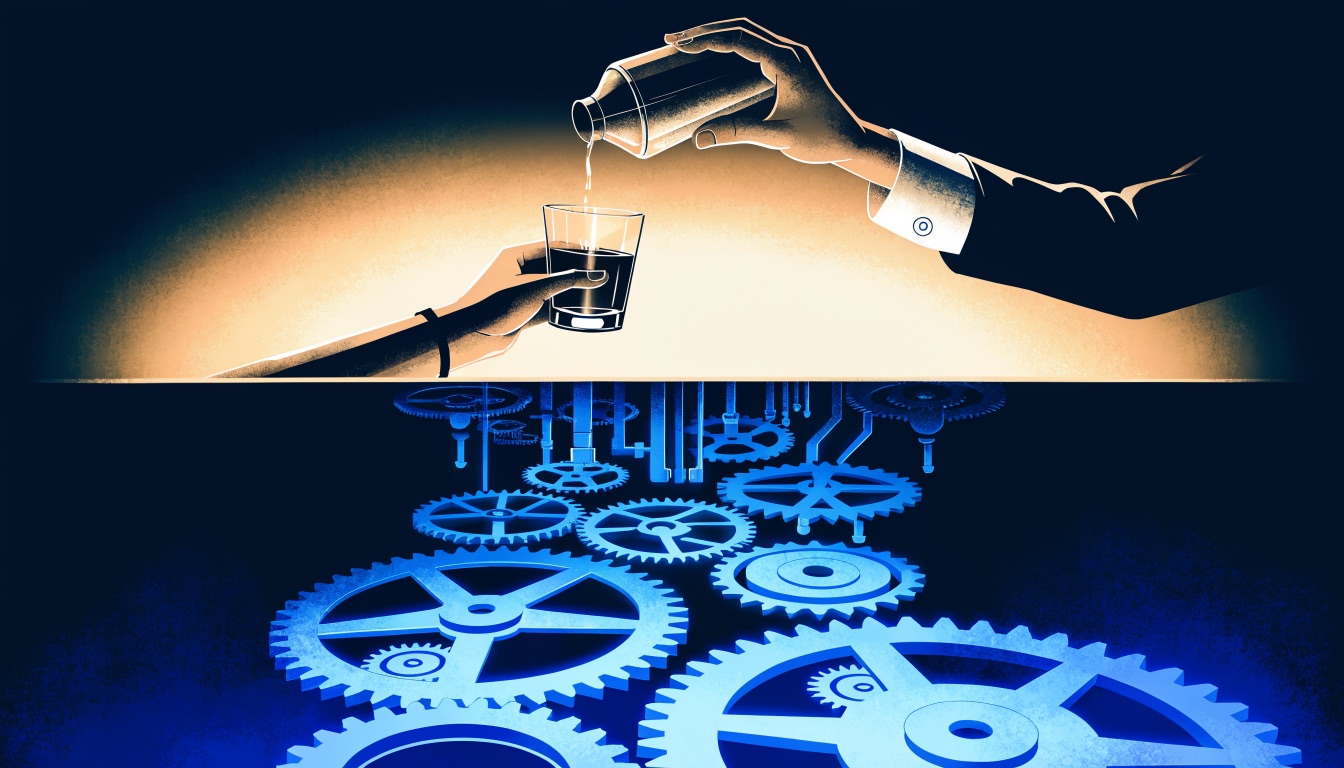
The most consistently useful thing AI does for me is also the least discussed, probably because it makes terrible marketing: it's something to think out loud with.
Running a small business is intellectually lonely in a way nobody warns you about. The decisions arrive constantly, they're all yours, and the people you'd most like to talk them through with are either employees (who deserve a boss who sounds reasonably sure), family (who deserve dinner conversations about literally anything else), or other owners (who have their own fires). So a tool that will engage seriously with a staffing question at eleven at night, ask reasonable follow-ups, and never once sigh turns out to be worth a great deal.
Like many entrepreneurs, I originally developed the sophisticated financial strategy known as "surely people will buy this." It worked out, eventually. But I'd have benefited enormously, in the planning stages, from a tireless outside voice asking "and what happens if they don't?" That's the job description. Not an oracle. A mirror that talks back. An actual advisor knows your business, has skin in the game, and can hold you accountable to last month's advice. AI does none of that, and forgetting the difference is how you end up taking strategy from a very confident autocomplete. But as a way to slow down, pressure-test a plan, and find the hole in your own reasoning before reality finds it for you, it has quietly changed how many of my decisions get made carefully instead of impulsively.
The second thing, related, is seeing options fast. Exploring an idea used to mean committing to it a little: real hours, sometimes real invoices. Now I can look at a dozen visual references before talking to a designer, draft five structures for a menu before choosing one, test three brand voices on the same paragraph, and storyboard a video idea in an afternoon. When we were developing the visual world of Rufus Hightower, our storyworld project, AI sat in the exploration loop exactly this way: dozens of directions considered cheaply, so the finished work could be developed by real professionals from a much stronger starting point. The value is never the specific output. The value is that seeing fifty options teaches you which one is right, and it used to cost too much to see fifty options.
The failure mode in both cases is the same: shipping the exploration. A prototype looks right at a glance and falls apart on inspection. If an AI image is your final marketing asset, you're using it wrong. If it's how you communicate a direction to a photographer, you're using it exactly right.
The boring wins
Then there's the invisible mountain. Every small business carries a backlog of internal work that never gets done because nobody has time: the training manual that exists only as oral tradition, the procedures living in one manager's head, the meeting that produced decisions nobody wrote down, the costing analysis you swore you'd update quarterly. This is the least glamorous category, and it's the one where I'd estimate AI earns most of its keep.
At Venetian, the specifics look like this. Training-session notes become documents a new hire can actually read. Recipes and procedures became a retrievable library instead of an archaeology project. Drink costing became a spreadsheet that flags problems instead of an annual guilt trip. Two-hour meetings become one page that people genuinely use. I wrote about the philosophy behind all this in Automate the Invisible. Humanize the Visible., but the operational summary is short: several hours a week came back, and several hours a week, compounded over a year, is a different business.
One category up from that is the one that has changed the most in the last two years: building actual software. A small operator with even minimal technical instincts can now stand up an internal web tool, write scripts for boring data tasks, wire together two systems that refuse to talk to each other, and prototype customer-facing experiences at a scale that used to require a small team. SodaBarVT, the interactive web experience we built for the lounge, is the kind of thing an independent bar simply did not ship twenty years ago, because the price of finding out whether it was worth building exceeded any sane definition of worth building. That shift is big enough that I gave it its own essay: Small Businesses Can Now Build Like Much Larger Companies. The short version here: prototype freely, and the moment something has to run in production for real users, bring in a real engineer. That part is not optional.
And yes, marketing content, the category everyone has heard about and the one where quality varies most wildly. AI will hand you a first draft of anything in seconds: posts, emails, captions, campaign concepts by the dozen. Treat all of it as raw material. Publish none of it as-is. Every model learned to write from a lot of the same internet, so the default voice is an averaged-out corporate oatmeal that belongs to nobody in particular, and if you pour it straight onto your channels, your brand starts sounding like everyone else's at a rate of exactly one post per post. Draft with the machine, then rewrite until it sounds like you. If you're not willing to do the second step, you're better off skipping both.
Where the rear end comes loose
Every failure I've had with these tools, and every failure I've watched another owner have, is some version of the kid flooring it: power applied with total confidence and no judgment. The specific gravel patterns are worth naming.
It makes things up. Dates, statistics, quotes, historical claims, entire people. Confidently, fluently, sometimes with citations that don't exist. Any factual claim gets verified by a human before it touches anything real. Every time. No exceptions for being in a hurry, which is of course precisely when the exceptions get made.
It loses the thread. A project that's been developing for weeks has to be re-primed with what actually happened. Assume it remembers nothing and you'll be pleasantly surprised instead of quietly sabotaged.
It defaults to generic. Generic prose, as covered, and generic visuals too: that slick, over-lit, vaguely corporate sheen every AI image reaches for unless you fight it. If your brand's aesthetic is anything other than "airport ad," you'll be pushing back on every single output, forever.
It absorbs whatever you feed it. Customer information, payroll numbers, anything you wouldn't want a competitor reading does not get pasted into a general-purpose tool. Use tools with appropriate data controls for anything sensitive, or don't use them for that at all.
And then the quiet one, the one that actually worries me: dependence. Use AI to reach a draft faster and you get leverage. Use it to replace the thinking itself and your judgment atrophies, which is a terrible trade, because judgment is the only thing in this entire essay the machine cannot hand you. The temptation compounds because the output arrives fast and looks finished. Fast draft, careful review. The order matters, and so does actually doing the second half.
None of this makes the tool bad, any more than the spin-out makes the Mustang bad. The rear end doesn't come loose because the car is malicious. It comes loose because physics doesn't grade on enthusiasm.
Here's the thing I'd actually tell another owner, though, after all the warnings. No single item on this list is transformative, and that's the part the breathless version of the AI conversation gets most wrong. Each use saves twenty minutes, or produces a slightly better prototype, or writes a slightly cleaner procedure. What's transformative is the compounding. An owner who works through these categories patiently, with human review on everything, looks up eighteen months later at a business that's better documented, tests more ideas, produces more, and, most importantly, has an operator with actual capacity again: time and attention for the parts of the business that require a human being. Not "10x." Not "revolutionary." A pile of boring wins. The boring wins are the whole game.
If you're starting from zero, don't try to automate everything at once. Pick one category. Get genuinely good at it. Then pick the next. Over a year, the whole operation quietly moves.
Which brings me back to the dirt road, because the part of that story that matters isn't the spin-out. It's the sequence. The uncle didn't open with a lecture on throttle control, and he didn't respond to the ditch by taking the keys back forever. He let the kid feel the power somewhere the mistakes were cheap, and then, at the exact moment humility arrived, he started teaching. That's the entire method, and it applies to a fourteen-year-old with a V8 exactly as well as it applies to a business owner with an AI subscription. Floor it. Feel the rear end go. Stall out in the dust. Fine. Possibly necessary. Just make sure it happens on a dirt road, with a ditch instead of a cliff, and not on the highway with the whole business riding in the passenger seat. The point of the car was never the horsepower. The point was where the kid, once somebody taught him to drive it, could finally go.
Related: Automate the Invisible. Humanize the Visible., Small Businesses Can Now Build Like Much Larger Companies, The Experience Economy Is Becoming the Human Experience Economy.