Small Businesses Can Now Build Like Much Larger Companies
The interesting story isn't that AI will let one person replace a corporation. The interesting story is that small teams can now afford to test ideas that used to be too expensive to try.
Here's a scene from the early years of my studio. I should be honest up front and say it's a composite, assembled from more nights than I'd like to admit, but every piece of it is real.
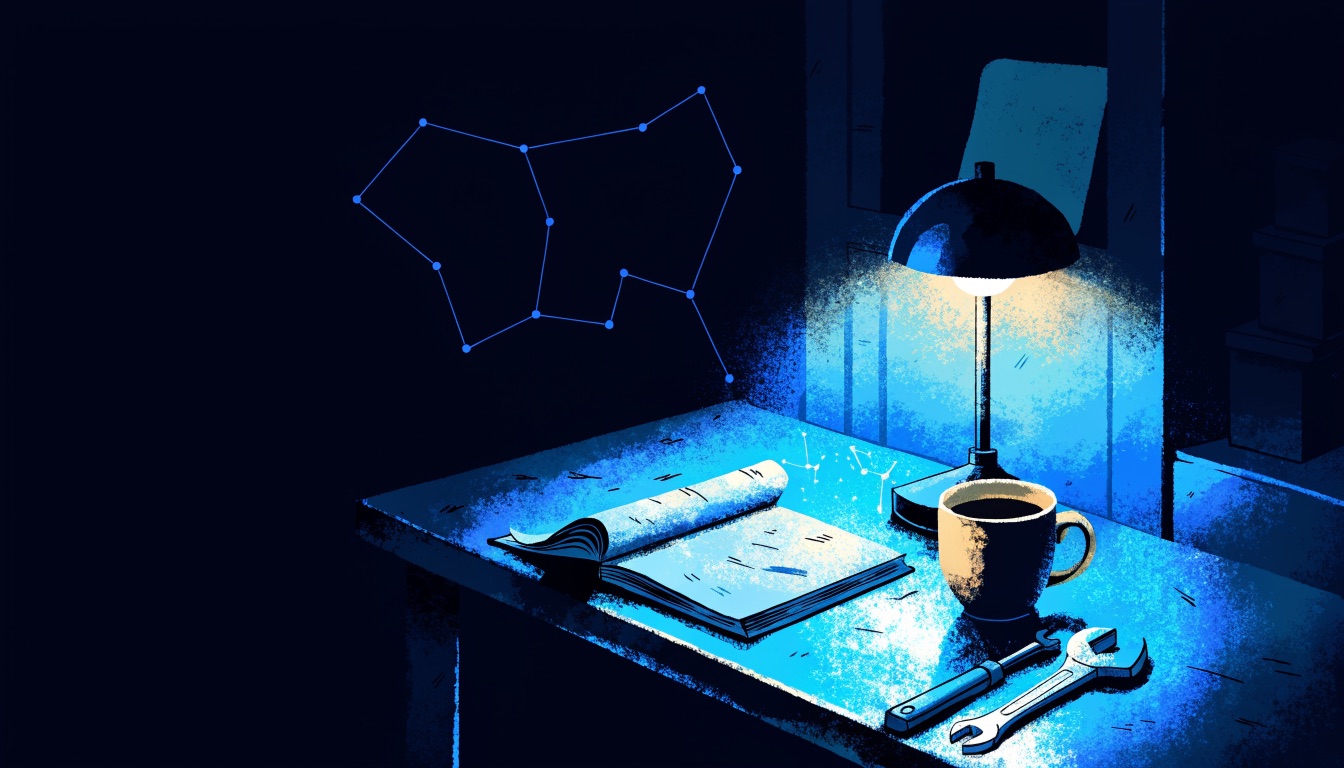
It's past eleven on a weeknight, sometime in the early twenty-tens. The office is dark except for one desk lamp and the glow of a monitor. There's a coffee on the desk that has been cold long enough to qualify as a different beverage. And open in the middle of everything is a notebook, the cheap kind with the cardboard cover, with an idea written in it and circled twice.
The idea varies depending on which night we're talking about. Sometimes it's an interactive piece for a client pitch. Sometimes it's a small app that would solve a real problem for a real audience. Sometimes it's a short film that needs one effect we can't produce in-house. The specifics change. The shape never does: it's a good idea, I believe in it, and I can't build it alone.
On the screen is the other half of the ritual: a reply from a development shop. It's polite. It's professional. It's thorough, honestly, and I have no notes on their process. It lays out a scope, a timeline, and a number, and the number has a comma in it. Not an outrageous number. A fair number, probably, for the work described. Just a number that belongs to a different company than mine.
So here's what happens next, and it's the reason this scene is worth staging at all: nothing.
Nobody says no. There's no dramatic rejection, no committee, no moment where the idea gets its day in court and loses on the merits. I read the quote twice. I do some arithmetic against the bank account, the kind of arithmetic you can do in your head because the answer was never really in doubt. I look at the notebook. I close the notebook. And the next morning work continues, client projects ship, invoices go out, and the idea is simply never mentioned again, like a houseguest who left before breakfast.
The notebook eventually goes into a drawer with the other notebooks, and over the years the drawer becomes a very specific kind of archive: a stack of feasibility studies that ended at the feasibility. Ideas that never even got the dignity of failing. They didn't die of rejection, because rejection at least involves consideration. They died of quote.
I want to tell you what I think has changed about that drawer, because it's the most useful thing I know how to say about AI and small business, and it isn't the thing the headlines keep saying.
The popular version of the story is that AI will soon let one person replace an entire corporation. This makes a tremendous headline and, on inspection, it's nonsense. Corporations do a great many things that no amount of tooling replaces, and one person still cannot carry the operational load of a hundred-person company on an ordinary Monday afternoon. If someone is selling you the one-person-conglomerate future, it's worth checking what else they're selling.
The real story is quieter, and it lives in that drawer.
The price of finding out
The constraint on small businesses was never ambition. Anyone who has run one knows the problem is usually the opposite: too many ideas, arriving at all hours, most vividly in the shower. Somebody running a bar or a boutique or a design studio can imagine no end of things they'd love to build. What stopped most of it from existing was something much more specific: the cost of finding out.
Every idea carries a price tag attached to the mere act of testing it. Hire the dev shop to build the prototype. Commission the concept art. Produce the sample video. Draft the document. Build the internal tool. Big companies could pay that price routinely, because the people who do the finding out (designers, engineers, writers, producers) were already on payroll. Exploration still cost money, but the machine for exploring already existed, and somebody upstairs had budgeted for a certain number of dead ends per year.
Small businesses paid retail. Every test was a real project with a real invoice, and if the idea didn't pan out, the money was simply gone. So small businesses responded the only rational way: they tested less. Fewer tests meant fewer bets, fewer bets meant fewer discoveries, and fewer discoveries meant the business stayed roughly the shape it had always been. Not for lack of imagination. For lack of affordable ways to find out.
The cruelest part is what that does to an owner over time. You learn to pre-reject yourself. After enough quotes with commas in them, you stop pricing ideas out at all, because you already know the shape of the answer, and eventually you stop writing some of them down in the first place. The constraint migrates from the bank account into the imagination, which is a far worse place for it to live. A business can survive being unable to afford an experiment. It has a much harder time surviving an owner who has quietly stopped proposing them.
Filmmaking went through exactly this, and it's worth a short detour because I came up through that world. In the early nineties, a young Texan named Robert Rodriguez wanted to find out whether he could make a feature film. The industry's definition of even a low budget still ran to six or seven figures, which meant that for a kid from San Antonio with no credits, the answer on offer was simply no. His response was to check himself into a medical research facility as a paid test subject, write his script during the study, and shoot El Mariachi for about seven thousand dollars. He later documented the whole thing in a book called Rebel Without a Crew, which reads less like a memoir than a heist. The movie is scrappy. That isn't the point. The point is the arithmetic: the price of finding out whether Robert Rodriguez was a filmmaker collapsed from impossible to one month of being a professional lab rat, and the answer turned out to be yes. Columbia picked the film up, and he has been making movies ever since.
Notice what cheap cameras did to filmmaking in the decades that followed. They did not replace cinematographers. Professionals still light and shoot everything you love. What changed was how many people got to find out whether they had something. The bottleneck moved from money to judgment. That's the shift I care about, because the same one is now arriving for every small business at once.
What actually changed
AI has not made experts obsolete. Real designers, engineers, writers, and producers remain far better than any tool at the level of finished professional work, and I expect that to stay true for a long time. What AI has done is collapse the cost of the first draft across almost every category of creative and technical work simultaneously. The first draft of a design direction. The first draft of a working tool. The first draft of a training manual, a costing model, a piece of concept art, a landing page, a piece of software.
Which means a small operator can now do things like this: produce ten prototype brand directions in an afternoon and bring the strongest one to a real designer for actual development. Wire together a working version of an internal tool in a week and find out whether it solves the problem before paying anyone to build it properly. Draft the training documents and procedures that used to require either a copywriter or a mythical quiet week that never arrives. Look at fifty pieces of concept art for what one used to cost. Stand up a landing page and have an answer to a business hypothesis by Friday.
None of that output is finished work, and that's fine, because none of it is pretending to be. It's the answer to a much cheaper question: is this worth pursuing at all? That question used to cost four or five figures to ask. Now it costs an evening, and the evening was going to be spent worrying about the idea anyway.
At Venetian, my soda lounge in Burlington, and in the projects orbiting it, I can point at specific results. The Rufus Hightower storyworld exists: its visual development happened with AI in the exploration loop, cheaply enough that we could afford to wander, and the elements worth keeping were then refined by actual professionals working from a far stronger starting point than a blank page. SodaBarVT exists: an independent soda lounge shipped its own custom interactive web experience for guests, a sentence that would not have survived contact with a budget twenty years ago. The staff-facing tools exist: the retrievable procedure library, the drink costing system, the training materials, the whole internal apparatus every manager swears they'll build during the slow season, the slow season being a place much like the horizon in that you never actually arrive there. And the experimentation rate went up across the board: events, specials, seasonal programs each cost less to prototype now, so more of them get tried. Some flop. That's the game. The ones that work are things the business would never have discovered otherwise.
I've written a category-by-category breakdown of the tools themselves in What AI Actually Does for a Small Business Owner, so I won't repeat it here. What I want to isolate instead is the meta-effect, because it's easy to miss while staring at any individual use: in almost every case where a small business does something new with these tools, the interesting question is not whether AI produced the final work. It didn't, if the business is doing this right. The interesting question is whether the idea got to exist at all.
Before, most small-business ideas died at the exploration stage. Silently. In a notebook. In a drawer. Now most of them can at least reach a testable prototype. The ones that prove out graduate to real development with real professionals. The ones that don't get killed cheaply, without the operator spending a month's revenue on the autopsy. The rate at which ideas get tried has gone up by an order of magnitude, and the rate at which ideas get tried is, over enough years, most of what separates a business that evolves from a business that calcifies. Each of the projects I listed above is a small effect on its own. Together, they're the reason this business has done more in the last year and a half than in the several years before it.
Scaffolding
The pushback I hear most often is some version of: fine, but the quality will still be worse than what a professional would have produced.
Yes. Sometimes much worse. I concede this completely.
The reason it matters less than it sounds is that the comparison is wrong. The AI-assisted prototype is not competing against a professional-quality version of the idea, because for a small business, the professional-quality version was never on the table at the exploration stage. The prototype is competing against the idea not existing. It's competing against the drawer. And for most of my working life, the drawer had a perfect record.
The healthiest way I've found to think about all of this is scaffolding. Scaffolding is ugly, temporary, and absolutely essential, and nobody standing on a sidewalk confuses it for the building. Once the shape of a thing is proven, you replace the scaffolding with real material, installed by people who know what they're doing. The failure mode, and you can watch it happening across the internet right now, is shipping the scaffolding: AI output pushed straight to customers as if it were the finished building. Every small business using these tools still has to know when to bring in the real designer, the real engineer, the real writer. That judgment is the entire game, and no tool supplies it. If anything, the tools raise the value of those professionals, because more proven ideas now arrive at their desks looking for real development, with the dead ends already cleared away on somebody else's time.
So if you run a small business, here's the version of this I'll actually stand behind. The layoff framing is mostly noise; the correct number of people for most small businesses to replace with AI is zero, because at our scale everybody already does three jobs and the people usually are the product. What the tools genuinely offer is different. Test more ideas per year. Kill the bad ones faster and cheaper. Develop the good ones further before committing real budget. Hand your specialists a strong starting point instead of a blank page. Build the small internal systems you were never going to get around to. None of that makes a headline. All of it compounds, and over eighteen months to three years it adds up to a business that has quietly become more capable than it was, without needing to become a different business.
I still keep notebooks. That habit survived everything. Ideas still show up at all hours and still get written down and circled, sometimes twice. What's changed is their life expectancy. An idea that gets circled now usually meets a prototype within a few weeks, and the prototype delivers a verdict one way or the other. A lot of those verdicts are unkind, and honestly, that's fine. Dying of being bad is the death an idea deserves. It's honest. The idea got its day in court.
Every so often I pull one of the old notebooks out of the drawer and flip through it. Some of those circled ideas were, in hindsight, terrible, and it's a genuine relief to finally know that. But a few of them would have worked. I'm fairly sure of it. There's no way to know which ones, because in the years they were written, finding out cost more than I had. That's the real story of AI and small business, and it has nothing to do with replacing anybody. The drawer is still there, in the literal sense; I'm sentimental about drawers full of old notebooks. It's just gotten much, much harder for an idea to end up in it.
Related: What AI Actually Does for a Small Business Owner, Automate the Invisible. Humanize the Visible., The Experience Economy Is Becoming the Human Experience Economy.