Automate the Invisible. Humanize the Visible.
A working philosophy for using AI inside a business that lives or dies by the quality of its human moments.
It's a little after nine on a Friday night at Venetian, and the room is doing the thing I like best, which is that nobody is looking at their phone. The lights are down to candle level. The band is between songs, so the place is running on that low murmur a good night generates all by itself: glassware, laughter, forty conversations at half volume. Behind the bar, one of my bartenders is working through tickets with the particular economy of motion you only develop after a few hundred nights like this one.
A woman at the end of the bar flags her down. She was in about six weeks ago, she says, and she had a drink she's been thinking about ever since. She doesn't remember what it was called. It was a special. It had something smoky in it, maybe a tea. She's aware, she adds, that this is not much to go on.
Here's what she doesn't know. Specials at a place like ours rotate constantly, and a drink from six weeks ago is ancient history. In the old version of this story, that recipe lives in exactly three places: a notebook that might be behind the syrup bottles, a text thread between me and whoever invented it, and the head of a bartender who is not working tonight. In the old version of this story, my bartender apologizes warmly, offers something in the same neighborhood, and the woman says that's fine. And it is fine, the way a near miss is fine. She wanted a specific memory back and got a decent substitute. Nobody complains about a night like that. Nobody tells anyone about it, either.
Here's what actually happens. My bartender turns to the staff tool, types roughly two sentences into it, something like "smoky special from about six weeks back, might have had a smoked tea in it," and the recipe comes back with the full spec. Build, glass, garnish, the works. She reads it once, makes the drink, and sets it down with a line I could not have scripted better: "We had to pull this one out of the archives for you."
The woman's whole face changes. Total elapsed time, maybe a minute. And here's the detail I keep replaying: the bartender never left the conversation. She didn't disappear into a back room. She didn't text me. She didn't apologize for the limits of human memory. The search happened inside the flow of service, invisibly, and what the guest experienced was a person who took her half-remembered craving seriously and then delivered on it.
She'll tell that story as "they remembered my drink." Which, in every way that matters, we did.
I want to talk about that minute, because I think it contains most of what I believe about AI in a business like mine.
The consultant class figured out AI in about a week, and their slide decks are already exhausting. Somewhere between the fifteenth email from someone who invented themselves as an "AI thought leader" last Tuesday and the eight-hundredth LinkedIn post promising to 10x my synergies, I noticed that nearly all of it orbits a single question: where can I use AI to replace a person?
I think that's a stupid question. It's stupid because it assumes labor is the problem, and in a business built on human contact, labor is usually the actual product. If your restaurant's competitive advantage is that guests feel welcomed, and you replace the person doing the welcoming with a screen, you have not innovated. You've made your business worse in a way that will show up in the numbers about six months later, by which point the consultant is gone.
The better question, the one that Friday night keeps answering for me, goes like this:
Which parts of my business should disappear into automation so my people have more capacity to be human?
That's a completely different problem, and it moves the technology into a completely different part of the building.
The two layers
Every business has two categories of work. The visible layer is the part guests, clients, or customers see and feel. The invisible layer is everything that makes the visible layer possible: ordering, reconciling, documenting, costing, scheduling, digging up the recipe, answering the fourth "what time do you open on Sunday" of the morning, building the training document for the new hire, extracting a usable summary from a two-hour meeting nobody wants to relive.
The invisible layer is where an enormous amount of a small team's mental and emotional energy goes. It's also where almost none of the competitive advantage lives. Nobody has ever come back to a restaurant because the opening SOP was beautifully organized.
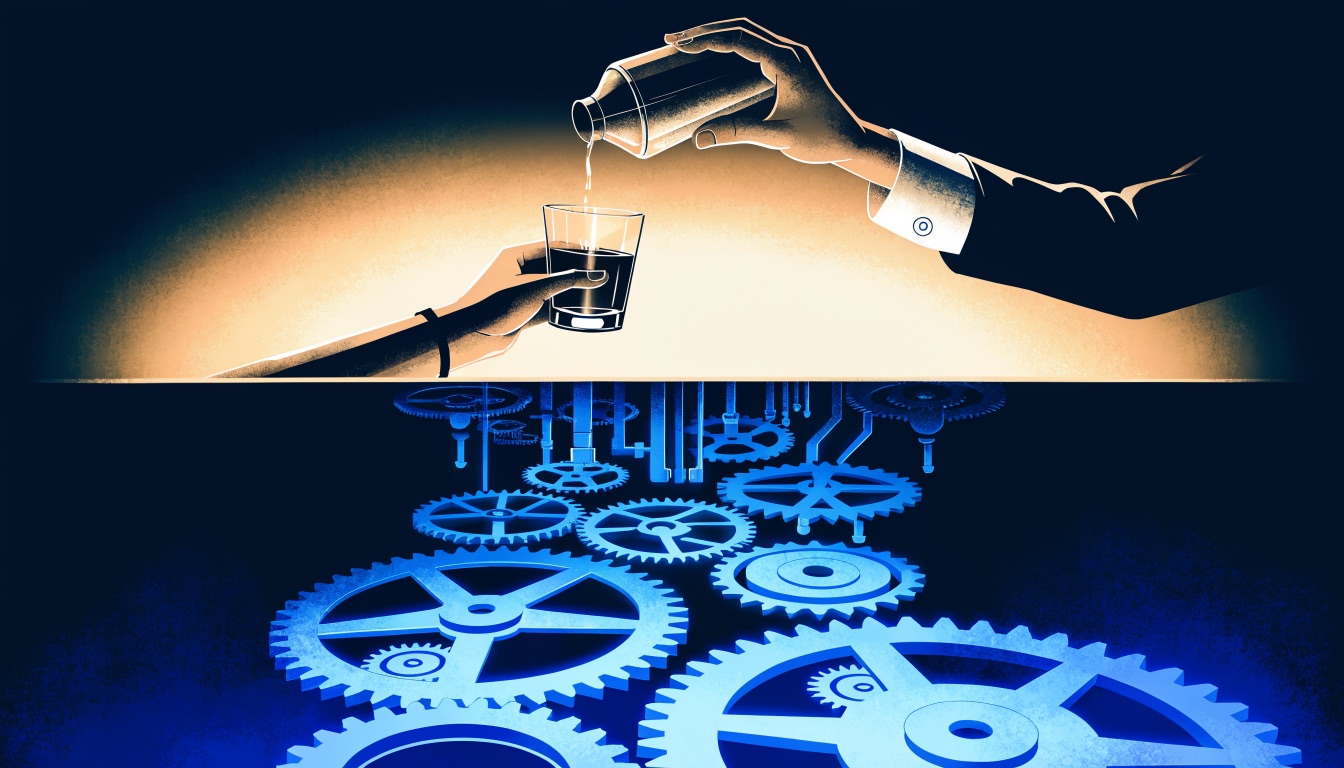
There's a story from the early years of Disneyland that I think about more often than is probably healthy. Walt Disney was walking through his park one day when he spotted a Frontierland cowboy cutting through Tomorrowland on the way to his shift: a costumed gunslinger strolling past the rockets. As the story is told, the sight bothered him for years. The cowboy wasn't doing anything wrong. The problem was that the operational life of the park had leaked into the show, and the moment a guest sees the seams, a world quietly turns back into a facility. So when his team designed the Magic Kingdom in Florida years later, they effectively built the park on a second story, with a network of corridors underneath it, so that costumes, deliveries, trash, and off-duty gunslingers could move through the operation without ever crossing a guest's sightline. The vocabulary that grew up around that idea stuck, and I've been stealing it ever since: onstage and backstage.
The lesson isn't "build tunnels." The lesson is that backstage exists to serve onstage, and a business that confuses the two damages both. When I'm deciding where AI belongs in my operation, that's the entire map. AI lives backstage.
And backstage happens to be where this technology is at its best, because backstage is where its failure modes are cheap. If it summarizes a meeting badly, you re-run it. If it drafts a clumsy procedure, you edit it. If it costs a drink imperfectly, you catch it and fix it. Onstage, where a guest is standing in your room having a feeling, humans still do a better job than any system I've seen, and I suspect they will for a very long time. Not because the technology is weak. Because the job onstage was never information retrieval. The job onstage is attention.
What I hand over, and what I won't
At Venetian, my soda lounge in Burlington, and at RetroMotion Creative, the studio I've run since 2009, the invisible layer now carries a lot of quiet weight.
The recipe retrieval you've already seen. The same system holds opening and closing procedures, prep lists, the sauce that has to be made before the kitchen winds down, all of it available to whoever needs it in the middle of a shift instead of living in the heads of whoever happens to be scheduled. A new hire's third night starts to look like a veteran's third year, not because the new hire suddenly knows more, but because the knowledge stopped hiding.
Drink costing runs the same way. Ingredient cost, pour cost, target margin, current price. It's a calculation you can and absolutely should do by hand, and it's also a calculation that mysteriously stops happening around the fifth week of a busy month. Now a spreadsheet flags anything out of range without a human needing to remember to worry about it.
Training materials might be the sleeper hit. Turning notes from a training session into a document the next hire can actually read, in a voice that sounds like us instead of a laminated corporate binder, used to be a project I'd lose a week to. Now it's an evening, and most of the evening is me editing. Meeting summaries, same story: a two-hour conversation becomes one page. Nobody ever re-listens to the recording. Everybody uses the page.
And then there's concept development, which is the one I'd defend in a bar fight. Before I show a collaborator anything, I can try twenty variations of an idea: three menu structures, a handful of visual directions, a mood board that took an evening instead of a month. The finished version still gets built by talented people. The exploration just no longer costs enough to prevent itself from happening.
None of this required an implementation partner or a Q4 initiative, which is worth saying out loud, because the enterprise version of the AI conversation makes small operators feel like they need permission and a budget line to start. The staff-facing tools we use are lightweight things, built in-house, maintained the way you'd maintain any other piece of the operation. The barrier to entry turned out to be an afternoon of curiosity, not a consulting engagement.
Notice what everything in this section has in common. None of it replaces a person. Every piece of it frees a person from the specific kind of low-value work that quietly eats a small business alive, and every piece of it creates capacity that the same person can spend onstage, which is the part of the business we actually get paid for.
Because the visible layer is a different country, and I try to treat the border seriously. The greeting stays human. A guest walking into the room should be looked at, acknowledged, and welcomed by a specific person whose job is to notice them, and no amount of touchless check-in improves on that. The moment of judgment stays human. When a guest is unhappy, a system cannot repair it; a person can, and usually does, provided they've been given both the information and the authority to solve the problem in front of them. The improvisation stays human: the night a table gets weird and needs an extra glass of something specific to unstick the moment, the odd request, the regular who came in tonight for reasons they haven't said out loud. All of that requires a person paying attention. The story of the room stays human, because a bartender explaining why the drink in front of you exists is hospitality, and a screen explaining it is signage. And recognition, that moment when a guest realizes you remembered them without being weird about it, stays so thoroughly human that I wrote about it separately in The Best Hospitality Makes People Feel Important.
There's a temptation, especially when the backstage automation is going well, to keep pushing it toward the light. I've watched operators lose the plot at exactly this point. Every time a business automates the visible layer, it saves a little money and gives up a lot of product, and the exchange rate on that trade is terrible.
The uncomfortable middle
Some work refuses to sit neatly on either side of the line, and I'd be lying if I claimed clean rules for it. Reservations are half invisible (the booking, the confirmation, the reminder, the log) and half visible (the moment a host looks up and greets a guest by name). The invisible half should be nearly frictionless. The visible half should not be frictionless at all. Friction, in the form of a human being paying attention to you, is the point. If your guest's first hello comes from a screen, you've automated the wrong half.
Marketing lives in the same gray zone. Draft with AI, absolutely; that's an eighty-percent head start on a vendor email or a press one-pager. But send it from a human, reply as a human, and rewrite until it sounds like a person, because the moment your marketing reads like it was optimized by an algorithm, guests can smell it, and it makes them like you a little less each time it happens.
For everything in the middle, I've given up on rules and settled on a question:
Would the guest, if they knew exactly which part I automated, feel that part was appropriate to automate?
Nobody minds that a machine filed the reservation. Everybody minds if a machine wrote the apology. When the honest answer is yes, automate it. When it's no, keep a person in the loop, no matter how good the demo is.
There's a larger reason I hold this line, beyond taste. One version of the AI conversation happening right now quietly writes down the value of humans in business. It presents itself as an efficiency argument, but it's really a bet, and I don't think it's a good one. If AI makes information, images, prototypes, and software increasingly abundant, then the scarce things become whatever it can't cheaply reproduce: genuine attention, physical presence, recognition by another person, trust built over time, a room made by somebody who cared. Those happen to be hospitality's home turf. They're where this industry has spent a hundred years building expertise, and they are the actual product. I've made the longer version of that argument in The Experience Economy Is Becoming the Human Experience Economy, but the short version fits in a sentence: everything that gets automated makes the unautomated things more valuable, and my whole industry is built out of the unautomated things.
So, the bumper sticker: automate the invisible, humanize the visible. AI should strip friction out of the systems, the research, the prototyping, and the repetitive work so that humans have more capacity for imagination, hospitality, judgment, and connection. It should increase human imagination, not decrease human contact. I keep the lines short because I've realized I'm going to be saying them for years.
But the version I actually carry around isn't a slogan. It's the woman at the end of my bar on a Friday night, getting back a drink she half remembered, from a bartender who never broke eye contact. Somewhere backstage, a system did its job perfectly, which is exactly why neither of them thought about it for a second. She went home with a story about a person. That's the correct ending. The machine's best work is the moment nobody notices it. The bartender's best work is the moment everybody does.
Related: What AI Actually Does for a Small Business Owner, Small Businesses Can Now Build Like Much Larger Companies, and The Experience Economy Is Becoming the Human Experience Economy.