Walt Disney Built Worlds. Then He Tried to Build Tomorrow.
A line becomes a character, a film becomes a world, a park becomes a place you can walk into. Then the question gets out of hand and becomes a city. Notes from inside a giant golf ball in Florida.
I am sitting inside a time machine, inside a giant golf ball, in Florida.
Spaceship Earth moves you slowly through the history of human communication. Thousands of years of people working out new ways to hand an idea to someone else. Cave walls, scribes, a printing press, a telephone. It is dark and it smells faintly of ozone and carpet, and the whole thing runs on a conviction that progress is a line going up.
And somewhere in that slow climb I started thinking less about the history and more about the look of the thing. The gleaming towers. The transportation. The machines that were going to make life effortless. Disney's future has a very particular shape, and the shape is unmistakably 1965.
Why does the future look so retro? And why am I enjoying it this much?
There is something strange about feeling nostalgic for a tomorrow that never turned up.
Then the ride ends, and I walk out, and I get in a car, and my phone tells me precisely where I am. Where I am is stuck in traffic.
The question that got out of hand
For most of us EPCOT is somewhere you go on holiday. You ride things, you eat things, you buy unusually expensive reminders that you rode and ate things.
But Walt's original EPCOT was not a park. It was supposed to be a community. A place where people actually lived and worked, where the experiment ran on residents rather than visitors. The park we know opened in 1982, long after his death, and by then it had become a different project entirely.
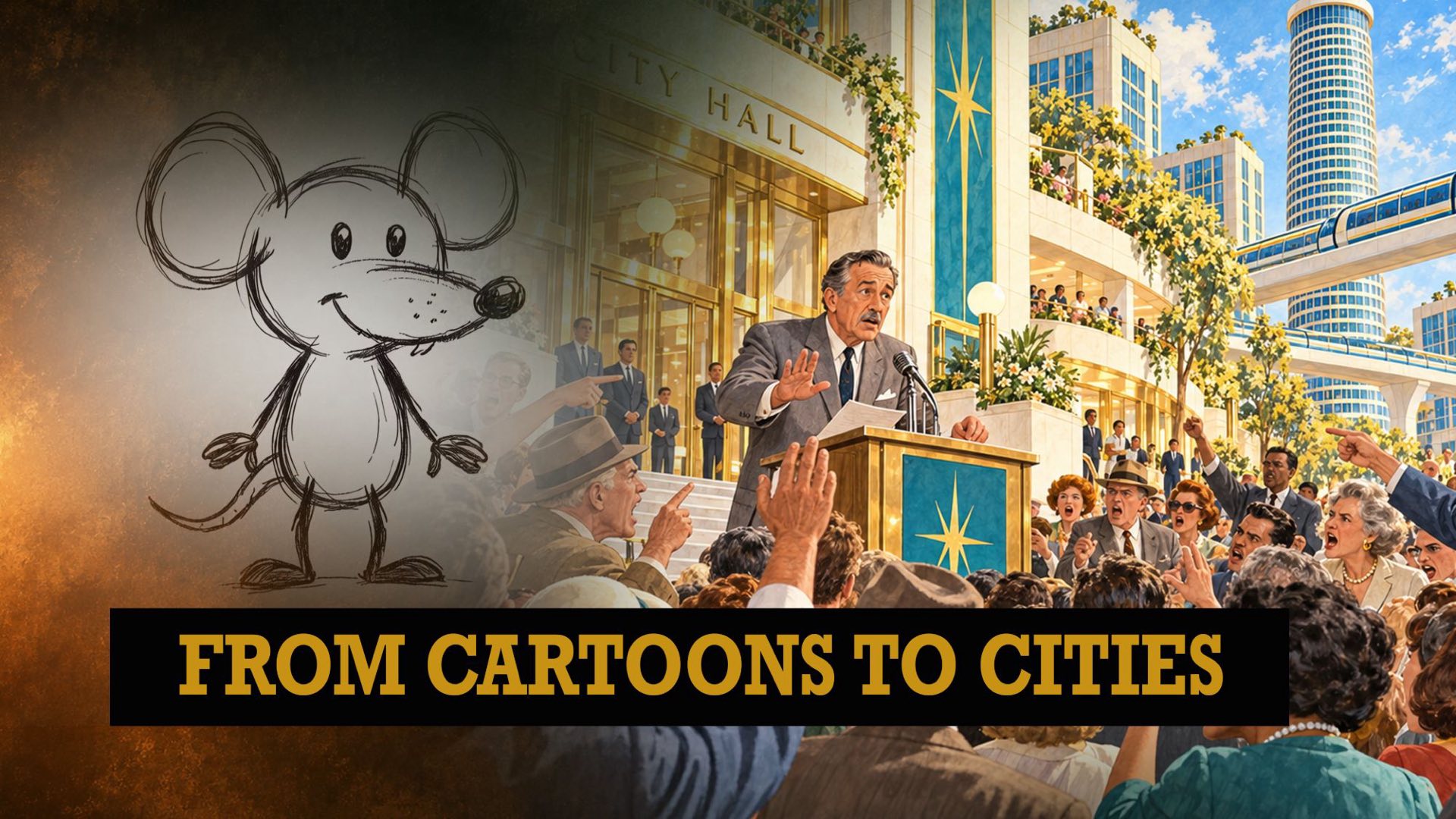
Which raises the question I could not let go of. How does a man go from making cartoons to deciding that American cities need a rewrite?
A city is a fairly substantial departure from a talking mouse.
I wanted to follow how the creative question grew. Not the biography, the question. What was he actually trying to answer each time, and what does it take to put an idea in front of people.
I have a selfish reason for asking. I opened a bar because I wanted to direct a film you could walk into.
A line, then a world
Start as small as it goes. A line can suggest a person. Give that person movement, timing, a gesture, and something begins to happen in the viewer rather than on the paper. You recognise a feeling in a few strokes of ink.
Walt and his collaborators kept pushing on that possibility. In 1928 Steamboat Willie made synchronised music and sound effects part of the performance, so the drawing could react, struggle, and make you laugh at the right moment. By 1937 Snow White and the Seven Dwarfs carried the work into a feature, which meant a studio full of artists could sustain an imagined world long enough for an audience to genuinely care what happened inside it.
That is the part of filmmaking that has always mattered to me. You arrange what somebody sees and hears, and the arrangement changes how they feel and what they understand.
But here is the limit. The audience stands up and leaves the theatre.
So what happens when they can walk into the world instead?
Outside the rectangle it is a cable problem
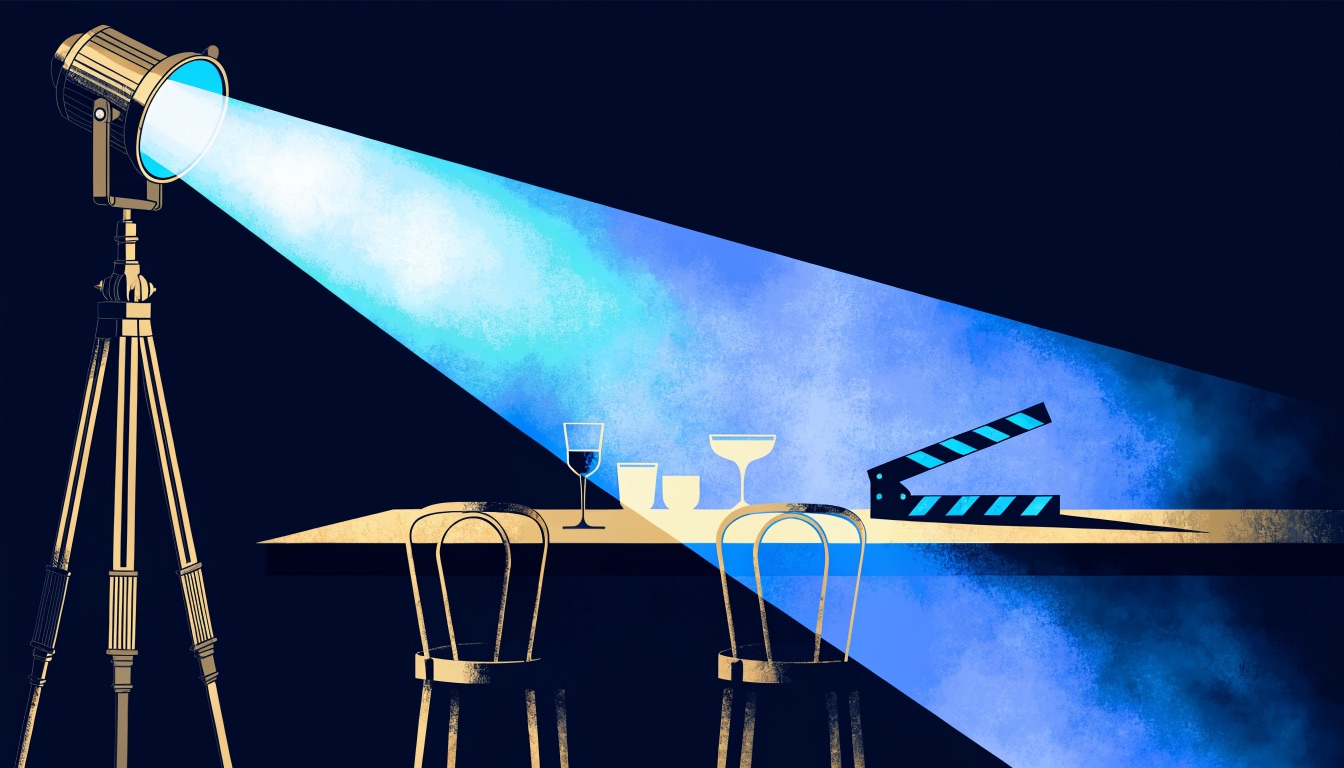
As a filmmaker I can make everything inside the frame look like another world. Pull back two feet and it is a cable problem, a light stand, a sandbag, somebody's lunch.
As a director I also control time. I choose where you look, I cut out the waiting, and I turn an entire evening into ninety seconds.
A venue takes all of that away. A guest can turn around. A guest gets hungry. A guest asks where the toilet is, and suddenly the imaginary world has to deal with plumbing.
Disneyland opened in 1955, and making an imagined place actually operate required designers, engineers, craftspeople and a workforce running it every day. WED Enterprises, which became Imagineering, had started during that development in 1952.
A beautiful drawing does not have to work in the rain. A ride does. Imagination turns out to have some very expensive consequences.
That is exactly where Disney connected to what I was doing in a twenty five seat room. A space can suggest an evening worth having, but somebody still has to welcome you, find you a seat, and get your order to the right person. The operation is what lets the place keep the promise the room is making.
Walt said something about this after ten years of running Disneyland that I keep returning to. He talked about what you learn by operating a thing, and what you might do differently if you started from scratch. That is not a designer talking. That is somebody who has watched the world collide with real people and found out what the drawing was missing.
The future had a sponsor
Hold the Disney story for a second, because the background matters more than the foreground here.
Those bright retro futures were imagined a couple of decades after the Second World War, in the middle of a Cold War, surrounded by nuclear anxiety. Cheerful pictures in a world with an enormous amount to worry about.
But look underneath the fins and the chrome. What is actually being promised is less drudgery, a more comfortable home, a family with more time together. Ingenuity offered a way to make the machinery of being alive feel less apocalyptic.
In 1953 Eisenhower's Atoms for Peace speech confronted the arms race while proposing peaceful uses of atomic energy. The same scientific achievement could improve a civilisation and destroy it. That is a fairly wide range of product outcomes.
In 1959 Nixon and Khrushchev argued about their competing systems while touring an exhibition that included a model American home. Part of it became known as the kitchen debate. The dishwasher had become a geopolitical argument.
This is the world Walt was working in, where a new machine could promise comfort, demonstrate the strength of a political system, or make the future frightening, depending on who was pointing at it.
Disney and General Electric turned one version of that promise into a family story. At the 1964 and 1965 New York World's Fair, the show that became Carousel of Progress followed electricity and new technology into the home across the decades. The appliances give the story something concrete to hold: easier work, more comfort, more time together. You are invited to imagine those possibilities in your own life.
And yes, the company helping tell that story also sold the appliances. The future had a sponsor.
For me that show is a glimpse of what EPCOT was reaching for. A creative work could help you imagine a change to ordinary life. A show can stage that promise for twenty minutes. A community would have to live with the result.
What the city actually proposed
So what would it look like if the home, the commute, the workplace and the evening out were all considered together?
Disneyland's site had taught Walt the value of room to expand, having watched development crowd in around it. Central Florida offered land, climate and access to the highways. From 1964 the purchasing effort quietly assembled roughly 27,000 acres through companies that concealed Disney's involvement. The highways made the site reachable by car, while the plan proposed something quite different for moving around inside it.
EPCOT was designed for about 20,000 people. Walt presented the problems of cities as a challenge and insisted the project start from public need: housing, work, schools, recreation and transportation, all considered at once.
Follow an ordinary day. You leave home and you need to get to work. People movers connect neighbourhoods to destinations. Monorails handle the longer journeys. In the city centre, pedestrians, cars and freight occupy different levels, so they stop fighting each other.
Then I hit the detail that pulled the whole thing into my own world. At the centre, a hotel of roughly thirty storeys, surrounded by restaurants, shopping, entertainment and offices, with the downtown enclosed and climate controlled. A place to spend an evening or welcome a visitor.
Hospitality was not an amenity bolted on afterwards. It was in the middle of the city.
The drawings even included streets representing places around the world, given character through food, merchandise and entertainment. You can see exactly which part of that idea survived into the EPCOT that actually exists.
And the experiment was meant to follow the resident through the front door. The homes were designed to accommodate new products and technologies, so the community could keep introducing and testing changes indefinitely.
That is the leap I find genuinely wild. The creative question had grown from what an audience could feel in a dark room to how an entire day might work for somebody.
The little figures never object
Here is the problem with a model, and I say this as someone who loves models.
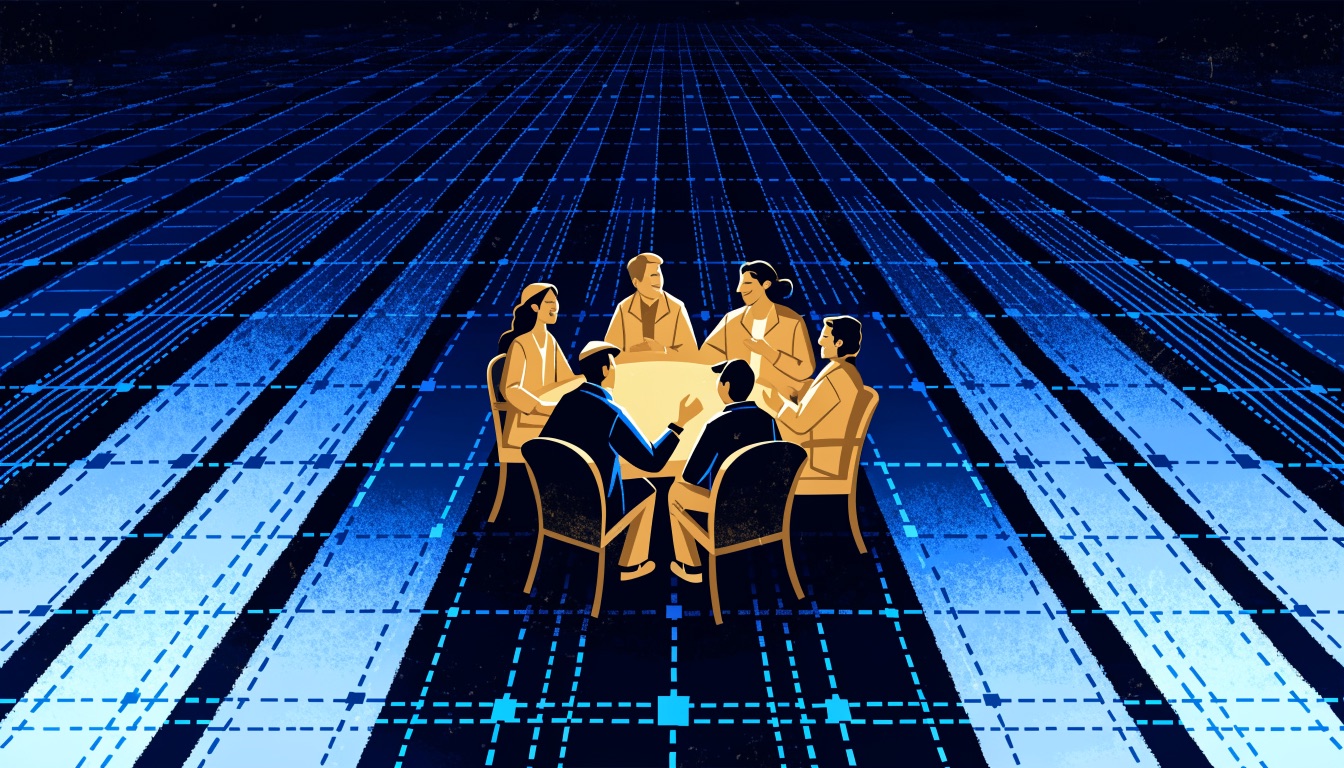
A model is persuasive because all the parts agree. Put the home here, the job there, connect them with a clean line. The tiny figure standing on the plaza never says they would rather live somewhere else.
A real person might. They might dislike the new technology. They might want a different neighbourhood, or disagree about what should change next, or simply want to be left alone.
A picture can make a proposal appealing. It cannot tell you whether the people living inside it would experience a better life. For that, they need a voice in what the improvement even means.
I can direct a scene. I can take responsibility for what a guest encounters in a cocktail lounge for three hours. But does a citizen need a meaningful say in the place where their entire life happens?
Walt said everyone living in EPCOT would have a responsibility to help keep the community an exciting living blueprint of the future. The district charter enacted after his death tied governing board elections to landowners by acreage, which makes the question of who was in charge of the plan a rather pointed one.
So when I say it feels like Walt wanted to direct an entire life, I am describing the reach of the proposal rather than accusing him of anything. We do not know how any of those decisions would have played out. But the bigger the world you shape, the more carefully you have to listen to the people living inside it.
It was never finished, which is the useful part
Walt filmed the EPCOT presentation in October 1966. He died that December.
The company opened the Florida resort in 1971 and kept reconsidering what EPCOT should be. Disney's leadership eventually concluded that combining a residential community with a public showcase was impractical, and over the following years the project became a place to communicate ideas through exhibitions, attractions, technology and international culture. EPCOT Center opened in 1982.
The work continued in a different form. That does not tell us whether the ideas in the city would have worked. Some might have made an ordinary day better. Others might have created problems of their own.
The completed city was never built, so its outcome stays open. Which means we can still try the individual ideas, watch what happens, and change them.
Back in the room
The creators of the past did build some remarkable things. We can carry maps, films, music, a camera and conversations with people on the other side of the planet, all in one object in a pocket.
And we can still all have a terrible afternoon.
The old pictures are useful because they let you ask whether the promise was actually delivered. More useful time. Less exhausting movement. Better places to go.
Most of us will never build a city. We might design a room, or help make an evening somebody remembers.
So here is the small version of the same problem, from my own twenty five seats.
At Venetian we ran jazz shows, and several guests told me other people were talking too loudly during the performances and spoiling it for everyone else. They wanted us to do something.
So I made a film. A short piece we played before the jazz shows, explaining that for tonight's performance, talking needed to be kept to a minimum.
I had opened the lounge because I wanted to direct experiences, and there I was, directing a film to explain what the experience was going to be. I am aware of how that sounds.
But notice what that gave us. The guests had identified something getting in the way. My response was a creative choice we could actually try. And now there was something specific to assess. Do people understand the invitation? Can the listeners hear the music? Can the team communicate it without making anyone feel told off?
That last one is the hard part.
Somebody wanting a louder social night might simply prefer a different event, and that is fine. But repeated confusion would have told us something less comfortable: that we had misread our audience, or failed to explain ourselves.
Listen to the guest and to the people doing the work. Try a change. Watch what happens. Refine it.
The model lets me propose a possibility. The people in the room are the only ones who can tell me whether it worked. That is precisely the learning Walt was describing after ten years of Disneyland. An idea meets people, and the next version is better because of the encounter.
The golf ball, again
So why does the future look so retro?
Because those imagined futures carry the technology, the hopes, the fears and the ideas about a good life belonging to the people who imagined them. A picture that once suggested new possibilities can now read as nostalgia. Different guests bring different meanings to the same room.
A place can look thoroughly old and still give somebody a wonderful experience. I thoroughly enjoyed being inside that one.
Its age is what makes it useful. It hands you two questions worth carrying out of the building.
What was this trying to make better? And what does it make possible for people now?
Walt had the nerve to keep asking bigger versions of the same thing. Can a drawing create a feeling. Can a film create a world. Can a place make an experience possible. And could any of that thinking improve ordinary life?
He put that last one on the drawing board and then ran out of time.
Our part is smaller and entirely available. Give the idea a form. Try it. Learn from the people whose experience you are shaping.
If you work in hospitality, I would genuinely like to hear about a guest response that changed how you do something.
FAQ
What was Walt Disney's original EPCOT?
EPCOT stood for Experimental Prototype Community of Tomorrow. It was proposed as a working community of around 20,000 residents rather than a theme park, with housing, employment, schools, recreation and transportation planned together. Walt presented it as an ongoing experiment in which the community would keep introducing and testing new products and technologies.
Why was the original EPCOT never built?
Walt Disney filmed the EPCOT presentation in October 1966 and died that December. The company opened the Florida resort in 1971 and continued reconsidering the project, eventually concluding that combining a residential community with a public showcase was impractical. The project became a place to communicate ideas through exhibitions, attractions, technology and international culture, and EPCOT Center opened in 1982.
How was the EPCOT transportation system supposed to work?
People movers would connect neighbourhoods to destinations, monorails would handle longer journeys, and in the city centre pedestrians, automobiles and freight would occupy separate levels so they did not conflict. Visitors would still arrive by car on the highways, but movement inside the community was planned differently.
What does EPCOT have to do with hospitality?
The plan put a hotel of roughly thirty storeys at the centre of the city, surrounded by restaurants, shopping, entertainment and offices in an enclosed, climate-controlled downtown. Hospitality was treated as part of the civic core rather than an add-on, which makes the plan a useful way of thinking about how a venue shapes the experience of a day.
Why does the retro future look the way it does?
Imagined futures carry the technology, hopes, fears and ideas about a good life belonging to the people who imagined them. The mid-century versions were produced in the aftermath of the Second World War and in the middle of the Cold War, so their cheerfulness is doing real work. A picture that once suggested new possibility now reads as nostalgia.
What is the difference between directing a film and designing a guest experience?
A filmmaker controls the frame and controls time, choosing where the audience looks and cutting out the waiting. A venue surrenders both. The guest can turn around, get hungry or need something practical, so the imagined world has to survive contact with operations. The room can suggest an evening worth having, but the staff are what keep the promise.